

Key Takeaways: Leaked CLARITY Act text would ban stablecoin yield “directly or indirectly,” including anything resembling bank deposit interest Activity-based […]
The post Stablecoin Update: CLARITY Act Leaked, Circle Stock Drops, Tether Calls in the “Big Four” appeared first on Coindoo.
Key Takeaways:
- Leaked CLARITY Act text would ban stablecoin yield “directly or indirectly,” including anything resembling bank deposit interest
- Activity-based rewards tied to user behavior may still be permitted under the proposal
- Industry reaction is split – some call it a “departure” from prior White House discussions, others say it’s the best realistic outcome
- Tether announces its first full independent audit by a Big Four firm as regulatory pressure mounts across the stablecoin sector
Neither development is incidental. Together, they point to an industry being forced to grow up fast.
The Leak
Details of the latest CLARITY Act draft surfaced this week after journalist Eleanor Terrett obtained an internal stakeholder email and reported on it via X. The text, which represents an attempt at compromise on the yield question that has long divided lawmakers and the crypto industry, lands harder than many in the space were expecting.


Under the proposal, platforms would be barred from offering yield on stablecoins – directly or indirectly – or in any manner that resembles a bank deposit. The restriction would extend to digital asset service providers broadly, covering exchanges, brokers, and their affiliates, with explicit language designed to close off workarounds. Anything “economically or functionally equivalent” to interest would be off the table.
There is a carveout – but it’s narrow. Activity-based rewards tied to user behavior, such as loyalty programs, promotional incentives, or subscription structures, would remain permissible, provided regulators don’t classify them as economically equivalent to interest. The SEC, CFTC, and Treasury would be jointly tasked with defining the boundaries of permissible rewards and putting anti-evasion rules in place within a year of passage.
Industry Reads the Room Differently
Reaction from insiders who reviewed the text has been divided, and that division itself tells you something.
One industry figure told Terrett the draft represents a clear “departure” from what had previously been on the table in discussions with the White House. The concern centers on the vagueness of the “economic equivalence” standard – language that future regulators could interpret expansively to squeeze out incentive structures that weren’t originally in the crosshairs. Restrictions on tying rewards to balances or transaction volumes add another layer of complexity for businesses trying to build viable products around stablecoins.
“Overall, this is a more narrow and restrictive approach toward crypto,” that person said.
A second source offered a more measured read. In their view, the text is largely what the industry should have anticipated – a framework that preserves transaction-based incentives while drawing a firm line against stablecoins functioning as de facto interest-bearing deposit accounts. They described it as broader than the earlier Tillis-Alsobrooks proposal, which would have imposed tighter constraints on the sector.
“This is the best possible result,” they said.
Bank representatives are reportedly scheduled to review the draft next, which will be the next real test of where the fault lines fall.

Why This Matters Beyond Washington
Circle’s stock dropped 20% to $101.17 on news of the regulatory developments surrounding the CLARITY framework – a signal that markets are paying close attention to how this gets resolved. The core issue is yield. Stablecoins have grown into the primary liquidity layer of the crypto market, and a significant part of their appeal at scale has been the ability to generate returns on holdings. Restrict that, and you don’t kill the asset class, but you fundamentally alter the incentive structure around holding them.
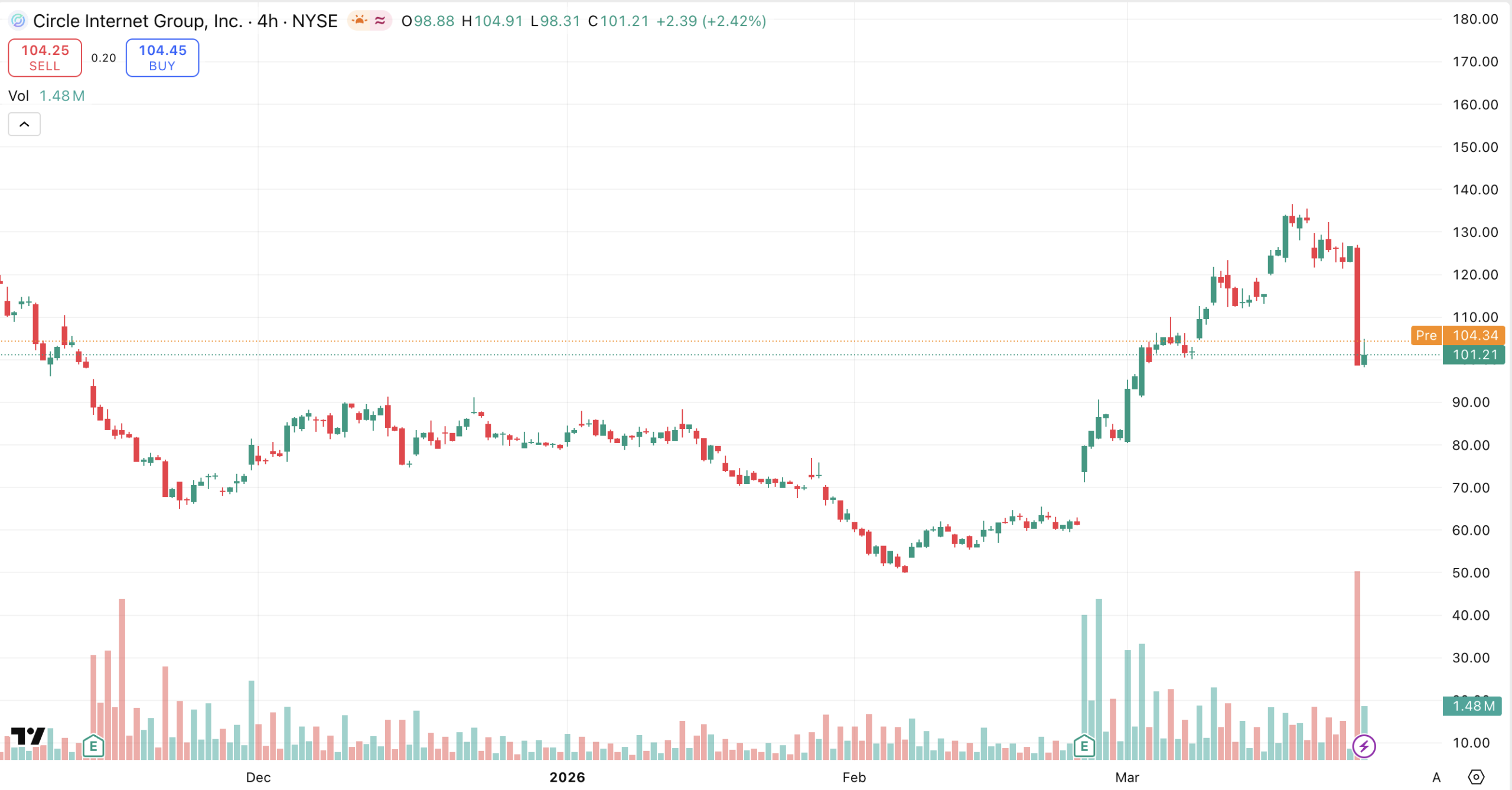
This isn’t theoretical risk. In 2022, the collapse of TerraUSD demonstrated exactly how fragile this segment can be when the mechanics underpinning it come apart. The stablecoin market is larger and more deeply embedded in the financial system today than it was then. The stakes for getting the regulatory framework wrong are proportionally higher.
Tether Makes Its Move
The biggest stablecoin issuer confirmed in a press release it has formally engaged a Big Four accounting firm to conduct its first full independent financial statement audit – what it is billing as the largest inaugural audit in financial market history given the scale involved.
Tether’s USDT sits at a market capitalization above $184 billion, with a claimed user base of over 550 million people globally. For an entity of that size, the absence of a full audit has long been a point of criticism. The company has relied on attestations – a less rigorous standard that has been standard practice across the stablecoin industry – but is now moving beyond that baseline.
The audit process began with an onboarding phase that concluded several weeks ago, during which firms assessed Tether’s internal controls, systems, and financial reporting. Multiple Big Four firms reportedly expressed interest, which Tether frames as a reflection of the significance of the engagement.
CFO Simon McWilliams, appointed in early 2025, has been central to preparing the company’s financial architecture for this level of scrutiny. “The Big Four firm was selected through a competitive process because the organisation is already operating at Big Four audit standard; the audit will be delivered,” he said.
Tether also disclosed that it will be moving listed securities in the coming days as part of ongoing reserve optimization – a detail worth watching given the timing and the regulatory environment surrounding it.
The Bigger Picture
Stablecoins have become too large and too embedded in global financial flows to operate in a regulatory gray zone indefinitely. The CLARITY Act leak – regardless of how the final text resolves – signals that Washington is moving closer to drawing the lines in the sector. Tether’s audit announcement signals that at least one major player has decided it’s better to define those lines on its own terms than to wait and have them imposed. Especially considering past controversy, where the company was accused of lack of transparency.
Whether the CLARITY framework ends up being workable for the industry depends heavily on how broadly regulators choose to interpret “economic equivalence” – and that question won’t be answered in the legislative text alone. It will be answered over years of regulatory guidance and enforcement.
And as “Crypto Dad” and former CFTC chairman Chris Giancarlo said, the U.S. banks are the only entities that will lose if the CLARITY Act is not pushed forward, so the American regulators have no choice, but to make this a reality.
The information provided in this article is for educational purposes only and does not constitute financial, investment, or trading advice. Coindoo.com does not endorse or recommend any specific investment strategy or cryptocurrency. Always conduct your own research and consult with a licensed financial advisor before making any investment decisions.
The post Stablecoin Update: CLARITY Act Leaked, Circle Stock Drops, Tether Calls in the “Big Four” appeared first on Coindoo.
Source: https://coindoo.com/stablecoin-update-clarity-act-leaked-circle-stock-drops-tether-calls-in-the-big-four/


More Crypto News
Check our Market Overview
Disclaimer: This article is for informational purposes only and does not constitute financial advice. Always conduct your own research (DYOR).