
Key Takeaways ETH exchange balances have hit an all-time low of 10.969%. The Ethereum Foundation completed its 70,000 ETH staking […]
The post Ethereum Exchange Balances Fall to All-Time Lows – What You Need to Know appeared first on Coindoo.
Key Takeaways
- ETH exchange balances have hit an all-time low of 10.969%.
- The Ethereum Foundation completed its 70,000 ETH staking target on April 3, 2026.
- Staking yield covers less than 5% of the EF’s historical operating budget.
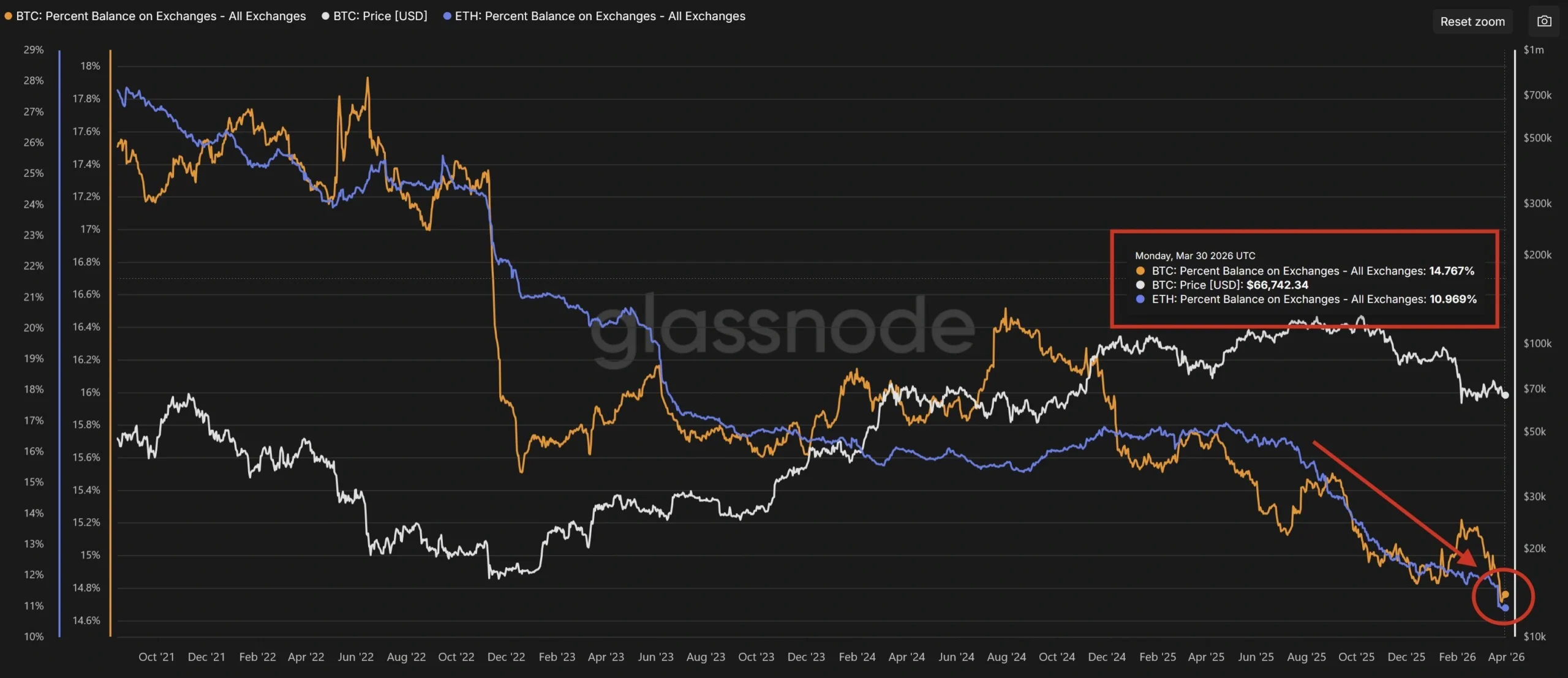
The numbers from Glassnode tell a clear story. ETH sitting on exchanges has fallen to 10.969% of total supply – an all-time low. Bitcoin is at 14.767%, its lowest reading since 2018. Taken together, these figures mark one of the most significant supply contractions across major crypto assets in recent memory. Holders, institutional and retail alike, are pulling coins off trading platforms at a pace that has no historical precedent for Ethereum.


According to data from Arkham Intelligence, on April 3, 2026, the Ethereum Foundation deposited 45,034 ETH – roughly $93 million – in a single transaction, completing its push toward a 70,000 ETH staking target. The Foundation now has approximately 69,500 ETH locked in validator operations, worth around $143 million. For years, the EF funded itself by periodically selling ETH. That model is now gone, and the switch to staking is not a minor accounting decision.
The Yield Math Doesn’t Add Up – And That’s the Point
The yield numbers are straightforward and they don’t make a strong financial case. At current staking rates of 2.7% to 3.8% APY, 70,000 ETH generates roughly $3.9 million to $5.4 million per year – call it $4.8 million at the midpoint with ETH around $2,100. The EF’s annual budget has historically run close to $100 million, covering protocol research, developer grants, and operations. Staking yield covers less than 5% of that. The EF is not staking because it solves a funding problem. It is staking because it changes what kind of institution the Foundation is – from a holder that sells to cover costs, to an operator that participates directly in the network’s consensus layer.
What the EF loses in flexibility, it gains in operational legitimacy. Solo-staking, as the Foundation has opted to do rather than delegating to a liquid staking protocol, means direct validator control with no third-party exposure. It keeps the Foundation embedded in the network’s core security mechanism rather than sitting as a detached financial entity that periodically liquidates holdings.
The Neutrality Problem
The downside of that position – and it is a real one – is that Ethereum co-founder Vitalik Buterin himself flagged it during earlier internal debates: when a validator is running, it is tied to a specific chain. In the event of a contentious hard fork, the EF’s validators don’t sit on the sidelines. They vote, implicitly, by their continued operation. For an organization that has gone to considerable lengths to position itself as a neutral steward of the protocol rather than a governing authority, that creates an unresolved tension that the 2026 roadmap has not yet addressed.

A Supply Shock in Slow Motion
The timing of the EF’s deposit also needs to be read against the broader supply picture. When Glassnode data shows ETH exchange balances hitting an all-time low simultaneously with the Foundation locking up 70,000 ETH in validators, the combined effect is a structural reduction in liquid supply. BTC holders pulling coins off exchanges are largely moving toward cold storage, consistent with the digital gold framing that dominates Bitcoin’s narrative. ETH holders doing the same thing are, in a growing number of cases, moving toward staking – treating the asset more like a yield-generating bond than a speculative position. The divergence between BTC and ETH behavior on exchange outflows reflects a genuine bifurcation in how each asset is being held and why.
None of this would have been operationally practical before the Pectra upgrade and specifically EIP-7251, which raised the maximum effective balance per validator from 32 ETH to 2,048 ETH. Running 70,000 ETH under the old rules would have required over 2,000 individual validator nodes. Under the new parameters, the same stake can be managed with a fraction of that infrastructure. The EF’s timing was not accidental – it waited for the technical conditions that made solo-staking at this scale manageable before making the move.
Infrastructure, Not Speculation
The broader institutional context adds another layer. BitMine and other large staking entities now hold positions that dwarf the Foundation’s 70,000 ETH. Spot ETH ETFs from 21Shares and Grayscale introduced staking yield pass-throughs earlier in 2026, bringing institutional-grade capital into validator economics. The EF’s decision to run its own validators rather than route through any of those products sets a precedent – a signal that the most credible long-term holders of ETH are not interested in intermediaries taking a cut of their participation in consensus.
What the combination of record-low exchange balances and the Foundation’s staking completion ultimately reflects is a market that has been quietly repricing what Ethereum is. Assets held on exchanges are, by definition, available for immediate sale. Assets in validators are locked, earning yield, and representing a bet on the network’s continued operation over a multi-year horizon. The shift in where ETH is being held is a shift in how it is being thought about – not as something to trade around quarterly price targets, but as infrastructure with a carrying yield and a governance function. The EF completing its staking target at the exact moment exchange balances hit an all-time low is less a coincidence than a convergence.
The post Ethereum Exchange Balances Fall to All-Time Lows – What You Need to Know appeared first on Coindoo.
Source: https://coindoo.com/ethereum-exchange-balances-fall-to-all-time-lows-what-you-need-to-know/


More Crypto News
Check our Market Overview
Disclaimer: This article is for informational purposes only and does not constitute financial advice. Always conduct your own research (DYOR).