Key Takeaways Tether issued investors a 14-day deadline to commit at a $500 billion valuation – or the round gets […]
The post Inside Tether’s Push to Become a $500 Billion Company appeared first on Coindoo.
- Tether issued investors a 14-day deadline to commit at a $500 billion valuation – or the round gets delayed again
- With ~300 employees and $10B in 2024 profit, Tether generates roughly $33M per employee – dwarfing Goldman Sachs by a factor of nearly 300
- The valuation hinges not just on USDT dominance but on a sprawling portfolio spanning AI infrastructure, biotech, and Bitcoin mining
- A Big Four audit, currently underway, is the key credibility bridge Tether needs before institutional capital moves in at scale
According to a report from The Information, the round targets a $500 billion valuation, a figure that would place Tether ahead of Bank of America ($352.9 billion market cap) and Goldman Sachs ($187.3 billion) and behind only JPMorgan Chase ($794.6 billion) among U.S. financial institutions. That comparison alone warrants scrutiny. Bank of America employs roughly 213,000 people. Goldman Sachs, around 45,000. Tether runs its entire operation with approximately 300 staff. Its reported net profit for 2025 was $10 billion – down about 23% from the prior year due to Bitcoin price weakness, but still a figure that most financial institutions would not refuse.
The Numbers That Make Wall Street Look Inefficient
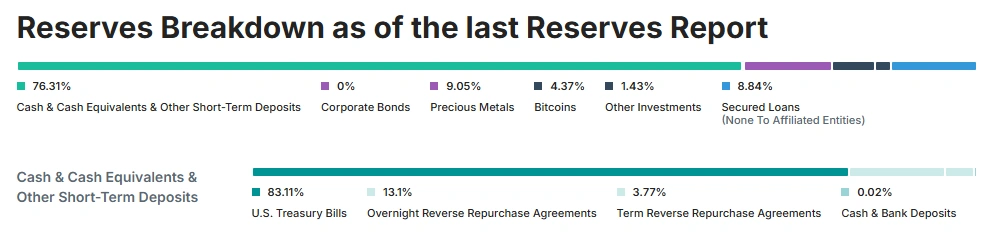
The profit-per-employee math is where the story gets genuinely strange. At $10 billion in annual profit across a headcount of 300, Tether generates roughly $33.3 million per employee. Goldman Sachs, by comparison, comes in at a fraction of that. The reason is structural, not accidental. Unlike traditional banks, Tether does not pay interest on USDT holdings. Holders of the stablecoin essentially lend Tether dollars, which the company then invests in U.S. Treasuries – currently around $122 billion worth – and keeps 100% of the yield. No depositor interest. No branch network. No compliance army in the tens of thousands. The margins are a direct function of the model.


Whether those margins justify a $500 billion valuation is an entirely separate question. At roughly 50 times annual earnings, Tether is asking for a multiple closer to a high-growth tech company than a financial firm. SpaceX, for reference, was valued at around $350 billion in early 2025 on projections that included satellite internet dominance and a Mars program (not it is valued at $1.75 trillion). The implicit argument Tether is making – that it belongs in that tier – rests on a strategic pivot that has been underway for several years but is now accelerating.
Beyond USDT: The Empire Tether Is Quietly Building
The company has committed significant capital to what it internally frames as a “sovereign tech ecosystem.” Through Northern Data Group, a German-listed firm in which Tether holds a 51% stake, it deployed over $600 million in debt financing to acquire thousands of NVIDIA H100 GPUs, positioning itself as a provider of AI compute infrastructure for clients who prefer to stay off Big Tech’s infrastructure. It holds a 48% stake in Rumble, the video platform, acquired for $775 million. It has invested in encrypted peer-to-peer communication protocols through Holepunch and Pears.com. In energy, it is a major backer of El Salvador’s $1 billion Volcano Energy project, using geothermal, wind, and solar capacity for Bitcoin mining, with an explicit goal of becoming the world’s largest miner.
Blackrock Neurotech, a brain-computer interface company in which Tether acquired a majority stake for $200 million. The firm has already implanted BCIs in over 40 patients to restore movement and communication – making it a direct competitor to Elon Musk’s Neuralink with actual clinical deployments rather than headline announcements. Tether also led a funding round valuing AI sleep technology firm Eight Sleep at $1.5 billion. These are not the investments of a stablecoin issuer filling out a balance sheet. They represent a deliberate effort to reposition the company around what CEO Paolo Ardoino has described as “Tether Evo” – a longer-term bet on technology that operates outside state-controlled infrastructure.

The fundraising effort itself has not been without turbulence. Earlier in 2026, advisors reportedly explored scaling the raise down to $5 billion after investor pushback on the headline valuation. Ardoino later clarified that the $20 billion figure previously circulated was a “maximum in hypothetical scenarios” rather than a fixed target – a clarification institutional investors largely ignored. The two-week ultimatum now circulating is, by most accounts, an attempt to force a close on a process that has dragged longer than planned.
Audit, Regulation, and the Road to Respectability
Tether is currently undergoing its first full financial review by a Big Four accounting firm, a process described internally as closing the “credibility gap” that has followed the company since its earliest days, when questions about whether USDT was fully backed by dollar reserves became a recurring story in financial media. The audit results, when published, will either provide the institutional legitimacy Tether needs to command the valuation it’s asking for, or hand skeptics fresh ammunition.
On the regulatory front, the company is advancing USAT, a U.S.-regulated stablecoin led by Bo Hines, a former White House official, designed to operate within the compliance framework that the GENIUS Act established. The stablecoin market is currently estimated at roughly $240 billion total, with projections from U.S. Treasury officials suggesting it could exceed $2 trillion within a few years. USDT’s current circulation stands at approximately $184–187 billion, more than double Circle’s USDC at around $77–78 billion – though USDC has been gaining ground steadily in regulated institutional markets where compliance infrastructure matters as much as liquidity. Tether’s dominance is real, but its trajectory in a fully regulated U.S. environment remains an open question, which is precisely why the audit and the USAT launch carry weight beyond optics.
Whether a 2026 IPO materializes depends heavily on how the current raise resolves. Tether leadership has publicly downplayed the necessity of going public, but the logic of an IPO – as a liquidity event for investors currently being pressured to commit at $500 billion – is not hard to follow. If the valuation holds and the audit clears, the conditions for a public offering could arrive faster than the company’s current statements suggest.
The information provided in this article is for educational purposes only and does not constitute financial, investment, or trading advice. Coindoo.com does not endorse or recommend any specific investment strategy or cryptocurrency. Always conduct your own research and consult with a licensed financial advisor before making any investment decisions.
The post Inside Tether’s Push to Become a $500 Billion Company appeared first on Coindoo.
Source: https://coindoo.com/inside-tethers-push-to-become-a-500-billion-company/


More Crypto News
Check our Market Overview
Disclaimer: This article is for informational purposes only and does not constitute financial advice. Always conduct your own research (DYOR).