

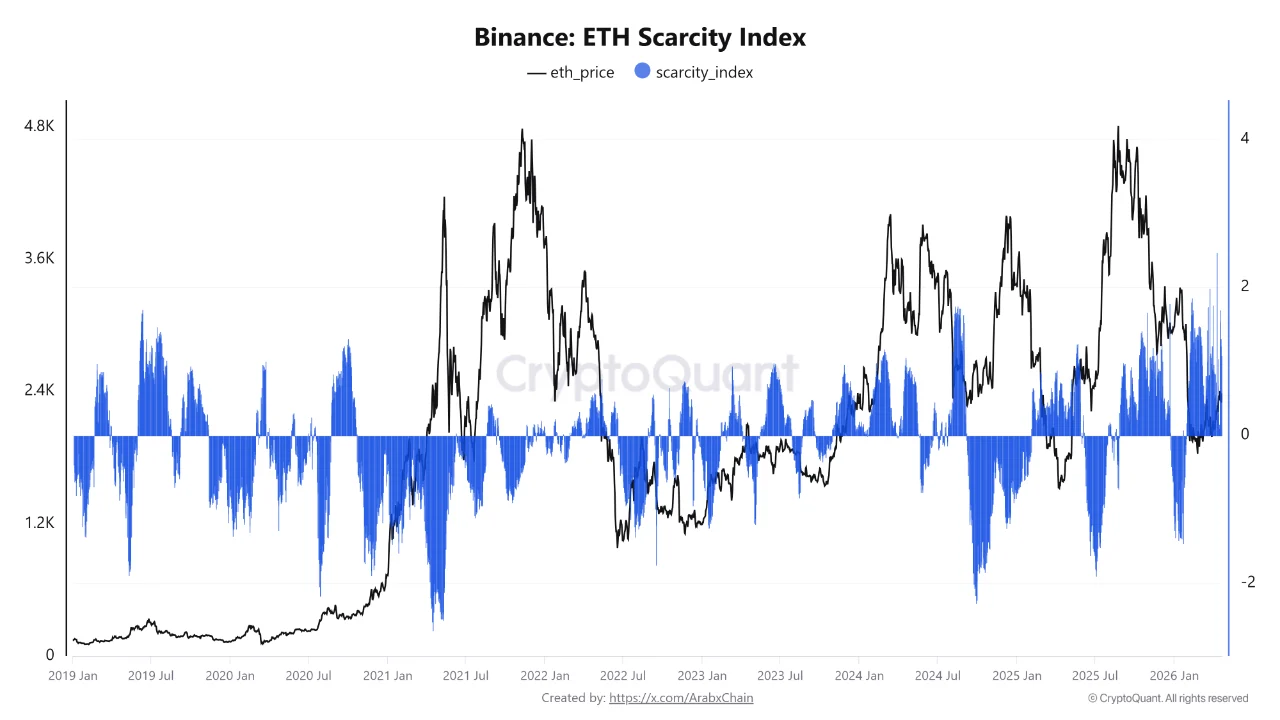
Key takeaways: ETH scarcity index hit all-time high of 2.47 on Binance in April. Index retreated but remains above 1. […]
The post Ethereum’s Scarcity Index Hit an All-Time High in April: Price Is Now Testing What That Means appeared first on Coindoo.
Key takeaways:
- ETH scarcity index hit all-time high of 2.47 on Binance in April.
- Index retreated but remains above 1.
- ETH price recovered from $2,260 low to $2,410 on April 22.
- Large volume spike confirmed demand on the recovery candle.
- RSI at 69.42 – just crossed below signal line at 70.23 at resistance.
- Resistance level: $2,420 on 1H chart.
- Index above 1 historically associated with price support, not weakness.
The Binance ETH scarcity index measures the relationship between available ETH supply on the exchange and demand for it. When the index is above zero, demand is outpacing available supply. When it goes negative, supply is exceeding demand. In April, it reached 2.47, a reading never recorded in the seven years of data visible on the chart, going back to 2019.
That record did not come at a price high. It came while Ethereum was correcting, supply tightening at the exact moment price was falling. That divergence is the signal worth paying attention to. The index has since pulled back from 2.47 but remains above 1, meaning the supply tightness that produced the record has not reversed, it has moderated.


What the price chart shows at $2,410
ETH dropped from $2,460 on April 17 to a low of $2,260 on April 20, an 8% correction in three days. The recovery on April 22 came on the largest volume candle since the April 17-18 peak, pushing price from $2,320 to $2,420 in a single move.
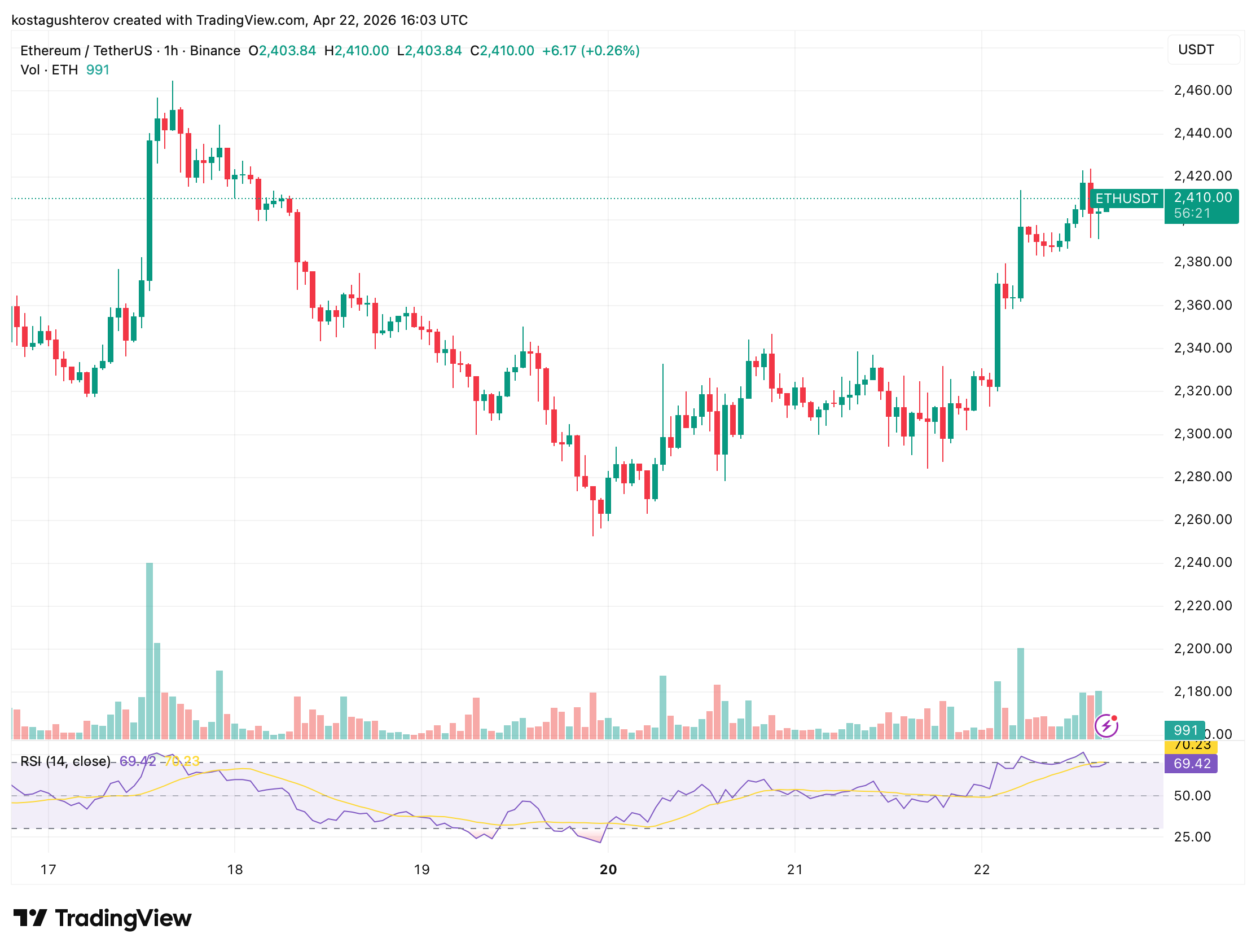
Demand was real on that candle. Price is now sitting at $2,410, directly below the horizontal resistance at $2,420 visible on the 1-hour chart. The RSI at 69.42 has just crossed below its signal line at 70.23, the first such crossover since the recovery began. Momentum is decelerating at the exact level where resistance sits.

The tension between the two datasets
Cryptoquant’s scarcity index argues for structural supply support. When available ETH on Binance is constrained relative to demand, sellers have less firepower. A record reading of 2.47 followed by a retreat to above 1 suggests the supply constraint remains tighter than normal, a condition that has historically preceded price stability or recovery rather than further selling.
The price chart argues for caution at $2,420. Resistance at a level where RSI momentum is fading is not a clean breakout setup. The volume on the recovery candle was strong but the candle that followed it was smaller, buyers pushed hard to $2,420 and then slowed.
The scarcity index sets the structural condition. The price chart determines whether that condition is being acted on. A close and hold above $2,420 changes the picture. A rejection sends price back into the $2,300-$2,380 range it spent the previous four days consolidating in.
The scarcity index set a seven-year record while price was falling. If ETH holds above $2,420, that record will look like it was leading price. If price gets rejected here and returns to the consolidation range, the record looks like a temporary imbalance that has already corrected. The next 24 hours at this level starts to separate the two.
The information provided in this article is for educational purposes only and does not constitute financial, investment, or trading advice. Coindoo.com does not endorse or recommend any specific investment strategy or cryptocurrency. Always conduct your own research and consult with a licensed financial advisor before making any investment decisions.
The post Ethereum’s Scarcity Index Hit an All-Time High in April: Price Is Now Testing What That Means appeared first on Coindoo.
Source: https://coindoo.com/ethereums-scarcity-index-hit-an-all-time-high-in-april-price-is-now-testing-what-that-means/


More Crypto News
Check our Market Overview
Disclaimer: This article is for informational purposes only and does not constitute financial advice. Always conduct your own research (DYOR).