Key Takeaways ETH trades near $1,790, recovered from its early-June low but still capped below every major average. Open interest […]
The post Ethereum Stalls in Neutral as a Major Protocol Upgrade Looms appeared first on Coindoo.
Key Takeaways
- ETH trades near $1,790, recovered from its early-June low but still capped below every major average.
- Open interest sits almost exactly on its 30-day average, with a Z-score of -0.28, a neutral reading.
- Spot ETFs drew $32M the week of June 16, the first positive week after a month of outflows.
- The Glamsterdam upgrade, ETH’s biggest since the Merge, has entered final testing as the next catalyst.
Ethereum has spent past days recovering from a sharp washout, climbing back to around $1,790 on 17th of June after 9% weekly gain, from an early-month low near $1,510. But the more telling story is not the bounce, it is how quiet the market underneath it has become. Leverage is neutral, ETF flows have only just stopped bleeding, and the price sits in no-man’s-land below resistance. This is a market waiting, and the most plausible thing it is waiting for is now in view.
The Derivatives Market Is Saying Nothing, Which Is the Signal
The most useful read on Ethereum right now comes from what the futures market is not doing. Open interest on Binance sits at roughly $5.54 billion, almost exactly on its 30-day average of $5.58 billion, and the 30-day Z-score is -0.28, statistically a hair below normal and effectively neutral. That single number rules out the two stories traders usually look for.
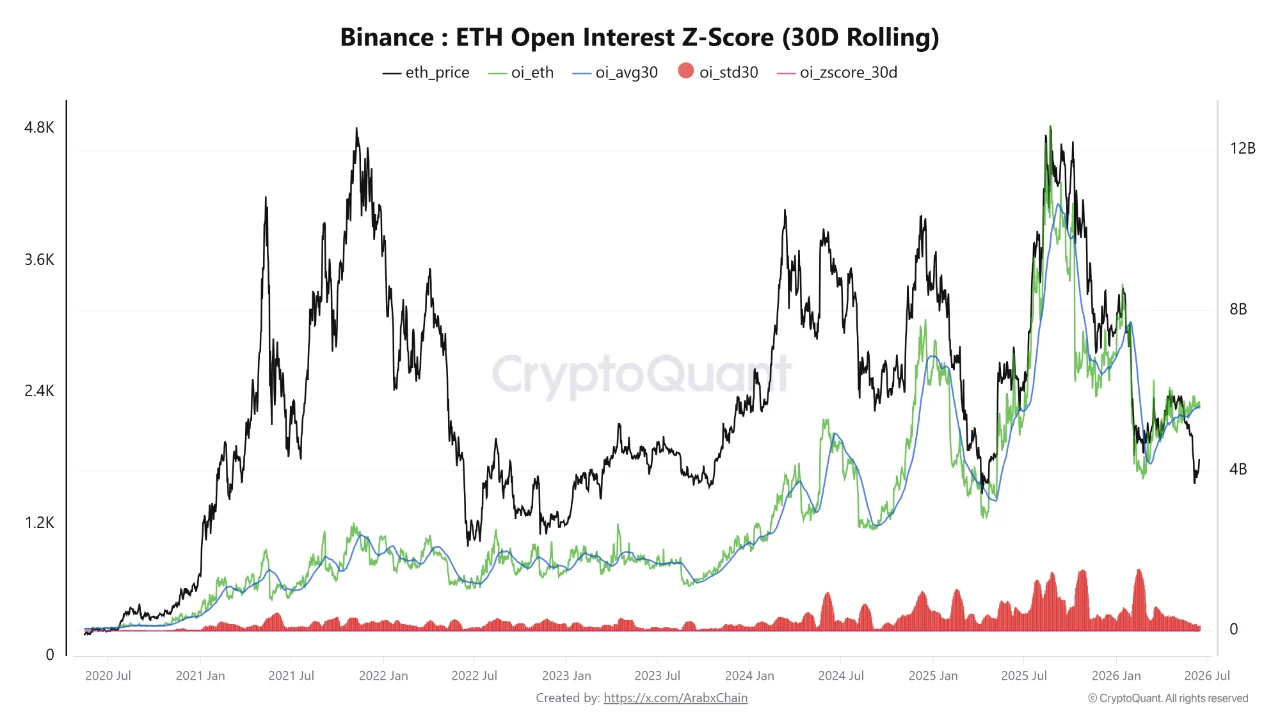


There is no speculative frenzy: open interest is not expanding far above its average, so traders are not piling into leveraged longs the way they do before froth-driven moves. And there is no capitulation: open interest is not collapsing, so positions are not being force-liquidated or abandoned. The funding rate confirms the calm, hovering only marginally positive after the early-June washout rather than stretching to either extreme. The honest interpretation of a Z-score sitting on zero is that participants are reluctant to make large directional bets, which is the positioning signature of a market waiting for a catalyst rather than trading one.
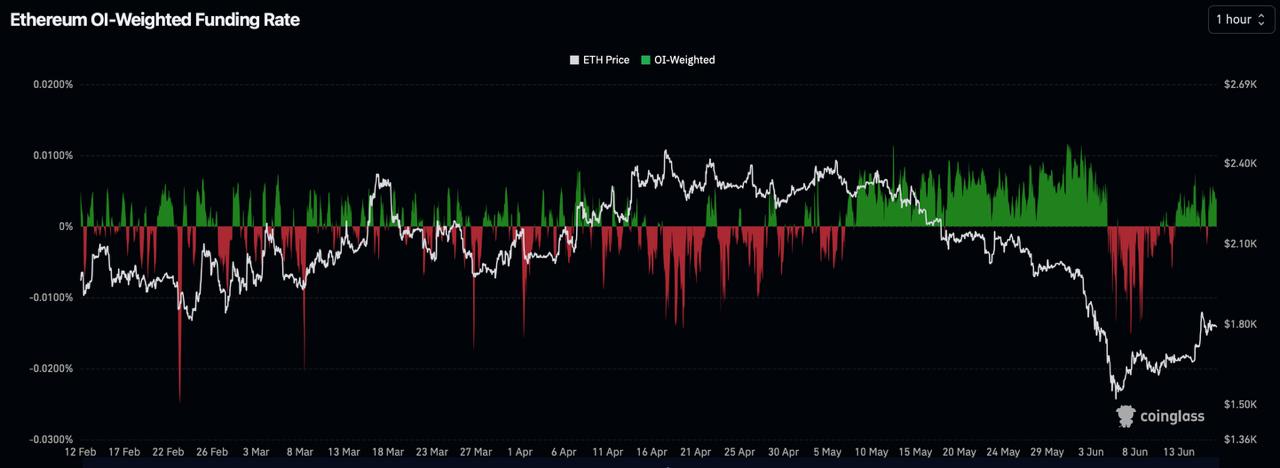
This also reframes the recent bounce. Because leverage is sitting at normal levels, the move off $1,510 is more likely driven by spot demand and broader sentiment than by a leverage-fueled squeeze. That makes it a different, and arguably healthier, kind of bounce than a frenzied one, but also a quieter one with less fuel behind it.
The Chart: A Recovery That Hasn’t Earned Anything Yet
The daily chart matches the neutral positioning. After bottoming near $1,510 in early June, ETH has climbed steadily to about $1,790, but it remains well below all three major moving averages, the 50-day at $2,038, the 100-day at $2,116, and the 200-day at $2,390, each still sloping down. The structure is a recovery inside a confirmed downtrend, not a reversal of it.
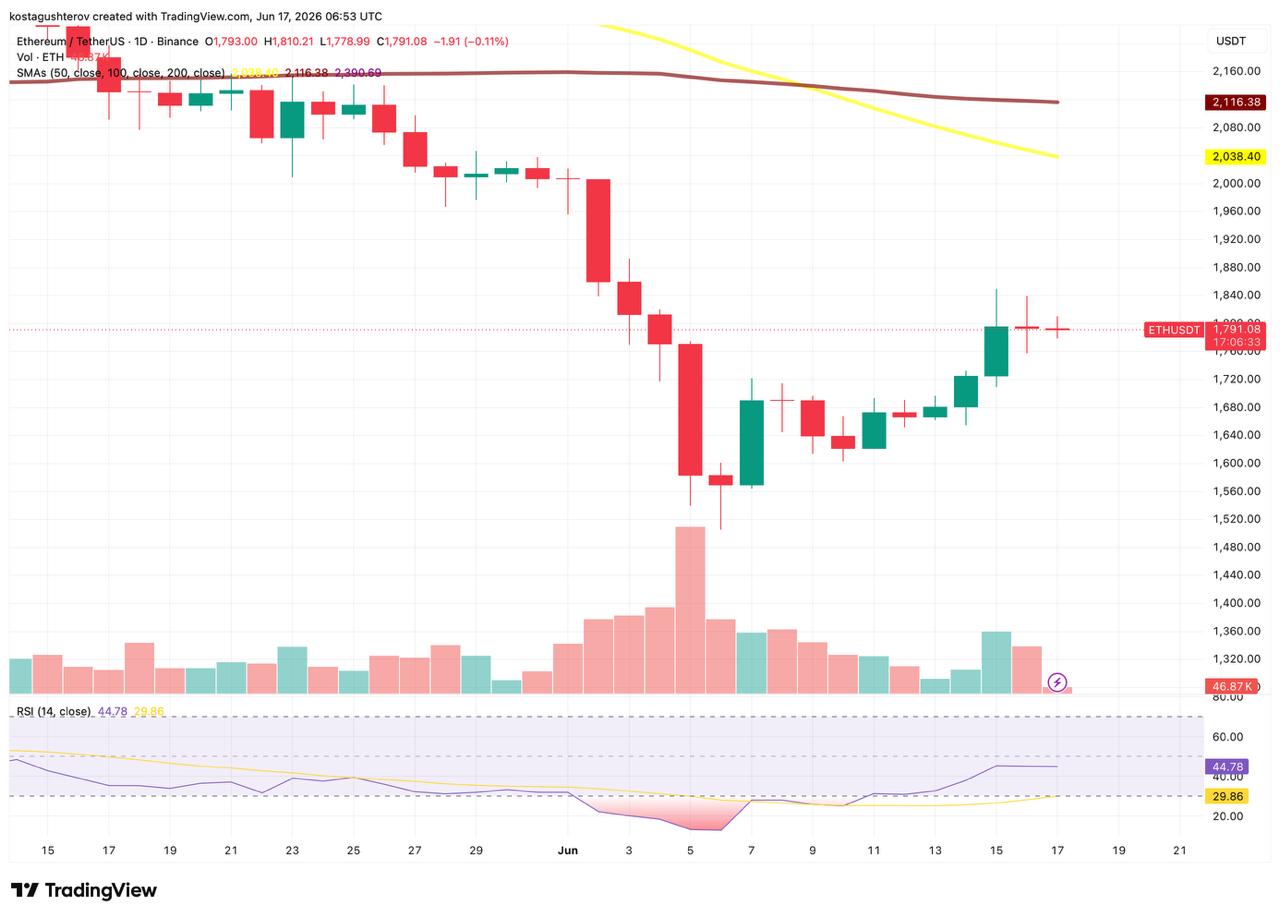
Momentum tells the same waiting story. The daily RSI has climbed off a deeply oversold reading near 20 at the June low to about 45, approaching the neutral midline without reclaiming it. That is the profile of a market that has stopped falling but has not yet proven it can advance. The first real test is the $2,038 fifty-day average; until ETH reclaims it, the rally is a relief move, and the price action is consistent with the indecision the derivatives data describes.
ETF Flows Just Stopped Bleeding
The institutional picture is where something has actually shifted, if only barely. After a brutal stretch of outflows, spot Ethereum ETFs lost roughly $255 million in the week of May 15, $216 million the week of May 22, and $241 million the week of May 29, the week of June 16 turned positive with about $32 million in net inflows. According to data from SoSoValue, it is the first positive weekly print in over a month.
The signal is real but should not be oversold. A single $32 million inflow week does not undo a month of redemptions, and the prior week (June 12) was still slightly negative. What it does mark is a possible inflection: the most relentless source of selling pressure on ETH this spring has at least paused, and if the inflows continue, they would supply exactly the kind of spot demand that a leverage-neutral market needs to actually trend rather than drift. This is the metric to watch precisely because it is the one showing the first genuine change of direction.
The Catalyst Coming Into View: Glamsterdam
The piece that ties the waiting market to a reason arrived this week from the developer side, and anyone who has watched Ethereum’s upgrade cycles knows to take the framing seriously. Glamsterdam, Ethereum’s next major upgrade, is now undergoing final-stage hardening, with teams running multi-client devnets that carry the full slate of planned changes before the code is frozen and shipped to public testnets. This is the deep end of the testing process, not its opening. Parithosh Jayanthi, a DevOps engineer at the Ethereum Foundation, framed its significance bluntly, calling it “probably the largest fork we’ve had since the Merge.” That comparison is not thrown around lightly in this ecosystem; the Merge was the moment Ethereum changed what it fundamentally was, so invoking it sets a high bar.
| Category | Details |
|---|---|
| Upgrade Name | Glamsterdam |
| Current Status | Final-stage hardening; running multi-client devnets |
| Significance | Likely the largest fork since The Merge |
| Primary Goal | Scaling the Ethereum Layer 1 base layer directly |
| Revised Timeline | Shifted from H1 2026 to Q3 2026 |
| Key Risks | ePBS implementation on the consensus layer carries propagation risk |
The substance behind the claim explains the weight. Glamsterdam’s two headline changes are Enshrined Proposer-Builder Separation (EIP-7732), which pulls block-building out of the off-chain relays that currently handle it and into the protocol itself, and Block-Level Access Lists (EIP-7928), which let transactions execute in parallel to lift Layer 1 throughput. In plain terms, one change targets the centralization and MEV problems that have quietly bothered Ethereum’s design for years, and the other goes after raw capacity. Taken together, they mark a deliberate turn back toward scaling Ethereum’s base layer directly rather than leaning on Layer 2s, which is a meaningful shift in priorities for a network whose competitive narrative has wobbled this year.
This is also where experience tempers the optimism. Ethereum upgrades of this magnitude rarely land on their first target date, and Glamsterdam is no exception: following the Soldøgn interop devnet that concluded in early May, the timeline drifted from its original H1 2026 aim toward a target now centered on the third quarter. The risk sits squarely in ePBS, which lands on the consensus layer, the part of the network where a bug does not stay contained but propagates across every validator. Seasoned observers will read the “final hardening” stage correctly: it is meaningful, late-cycle progress, but progress is not a launch date. The upgrade is the catalyst the quiet market appears to be holding out for, yet the prudent assumption is that it arrives later, and more carefully, than the early targets implied.
Putting the Pieces Together
Read in isolation, each data point is unremarkable: a modest bounce, a neutral Z-score, a small ETF inflow, an upgrade in testing. Read together, they describe a coherent moment. Ethereum’s price has stabilized, its derivatives market has gone deliberately quiet, its worst selling pressure has just paused, and its biggest structural upgrade in years is moving toward the finish line. That is the anatomy of a market in equilibrium waiting for a reason to pick a direction.
The signals that would break the stalemate are concrete. On positioning, a Z-score pushing toward +2 would flag leverage building rapidly and rising liquidation risk, while a move toward -2 would signal aggressive deleveraging and fear. On the chart, a daily close above the $2,038 fifty-day average would be the first technical evidence the recovery is more than a relief bounce. On flows, a second and third week of ETF inflows would confirm the spring’s selling has genuinely turned. And on fundamentals, a firm Glamsterdam testnet schedule would give the patient market the catalyst its positioning suggests it is holding out for. Until one of those moves, Ethereum’s futures market is signaling neither greed nor fear, only equilibrium and indecision.
The post Ethereum Stalls in Neutral as a Major Protocol Upgrade Looms appeared first on Coindoo.
Source: https://coindoo.com/ethereum-stalls-in-neutral-as-a-major-protocol-upgrade-looms/


More Crypto News
Check our Market Overview
Disclaimer: This article is for informational purposes only and does not constitute financial advice. Always conduct your own research (DYOR).