The technical release arrives under difficult market conditions: PI traded near $0.075 on July 16, approximately 97.5% below its February […]
The post Pi Network Sets v25 Upgrade With PI 97% Below Peak appeared first on Coindoo.
The technical release arrives under difficult market conditions: PI traded near $0.075 on July 16, approximately 97.5% below its February 2025 peak near $3.
The contrast defines the real test. Protocol v25 strengthens the infrastructure developers can build on, but it does not immediately create new applications, transaction demand or a reason to hold PI. After more than a year of persistent selling, the market needs evidence that technical progress is translating into economic activity.
Key Takeaways
- Pi will activate Protocol v25 on July 22.
- The upgrade adds BN254 and Poseidon cryptography.
- PI trades roughly 97.5% below its peak.
- New infrastructure does not guarantee immediate adoption.
- Utility and demand remain the decisive market tests.
Protocol v25 Improves the Plumbing
According to Pi Network’s official announcement, the July 22 upgrade primarily targets network stability and reliability while adding BN254 cryptography and Poseidon hashing.


These tools are designed for zero-knowledge proofs, which allow an application to verify that a statement is true without receiving all the information behind it. A user could, for example, prove that they completed an identity check, meet an age requirement or belong to an eligible jurisdiction without disclosing their full identity record to every application.
BN254 allows smart contracts to verify widely used zk-SNARK proofs more efficiently. Poseidon performs a related job at the hashing layer, reducing the computational burden inside zero-knowledge circuits compared with conventional algorithms such as SHA-256.
For Pi developers, the main benefit is compatibility. BN254 is already widely used across Ethereum-based zero-knowledge systems, allowing existing proof libraries and development tools to be adapted more easily rather than rebuilt around a different cryptographic curve.
The release is not presented as a major increase in transactions per second. Pi’s announcement emphasizes reliability and new cryptographic capabilities rather than publishing a new throughput target, lower transaction fee or shorter finality time.
On July 22, Pi is scheduled to upgrade to Protocol v25, which primarily focuses on improving network stability and reliability, and supports new capabilities for more efficient, privacy-preserving smart contracts.
Go to the Pi mining app to learn more! pic.twitter.com/Btg8aEFAFh
— Pi Network (@PiCoreTeam) July 15, 2026
The Upgrade Does Not Make Pi Transactions Private
Protocol v25 provides the building blocks for privacy applications, not a completed privacy layer. Developers must still create circuits, generate proofs, deploy verifier contracts and design the rules governing what information remains hidden.
“These primitives are foundational building blocks and do not, on their own, provide end-to-end private payments.”
That distinction comes from the Stellar Development Foundation’s technical documentation. Pi uses Stellar Core and Horizon components in its official node infrastructure, making Stellar’s explanation directly relevant to what Pi’s upgrade can and cannot deliver.
Protocol v25, known as X-Ray on Stellar, became active on the Stellar Mainnet in January 2026. Pi’s July adoption therefore brings established upstream capabilities into its own network rather than introducing a cryptographic system developed exclusively for Pi.
This lowers technical risk because the underlying functions have already entered production elsewhere. It also means the upgrade should be viewed as infrastructure modernization rather than a standalone product capable of generating immediate token demand.
The Most Relevant Use Case Is Private Identity
Pi’s strongest potential application for the new tools may be identity rather than fully private payments. The network has made KYC and verified human participation central to its ecosystem, reporting more than 60 million engaged Pioneers and millions of Mainnet migrations.
Zero-knowledge proofs could make that model less intrusive. Instead of repeatedly sharing personal information, users could generate a proof confirming that an approved verification process was completed. Applications would receive the answer they need without gaining access to the underlying identity document.
The architecture could support:
- Private eligibility checks for applications restricted by age or jurisdiction.
- Proof of unique humanity without exposing a user’s legal identity.
- Selective compliance in which only the minimum required information is revealed.
- Reputation systems that verify credentials without publishing the source data.
Those applications remain prospective. Protocol v25 makes them more practical to build, but adoption will depend on developers producing usable products and users choosing to interact with them.
PI Has Lost Nearly All Its Post-Launch Value
The technical release comes after an unusually deep market decline. OKX data places PI’s February 27, 2025 peak at the equivalent of approximately $3. By July 16, 2026, the token was trading close to $0.075, leaving it roughly 97.5% below that high.
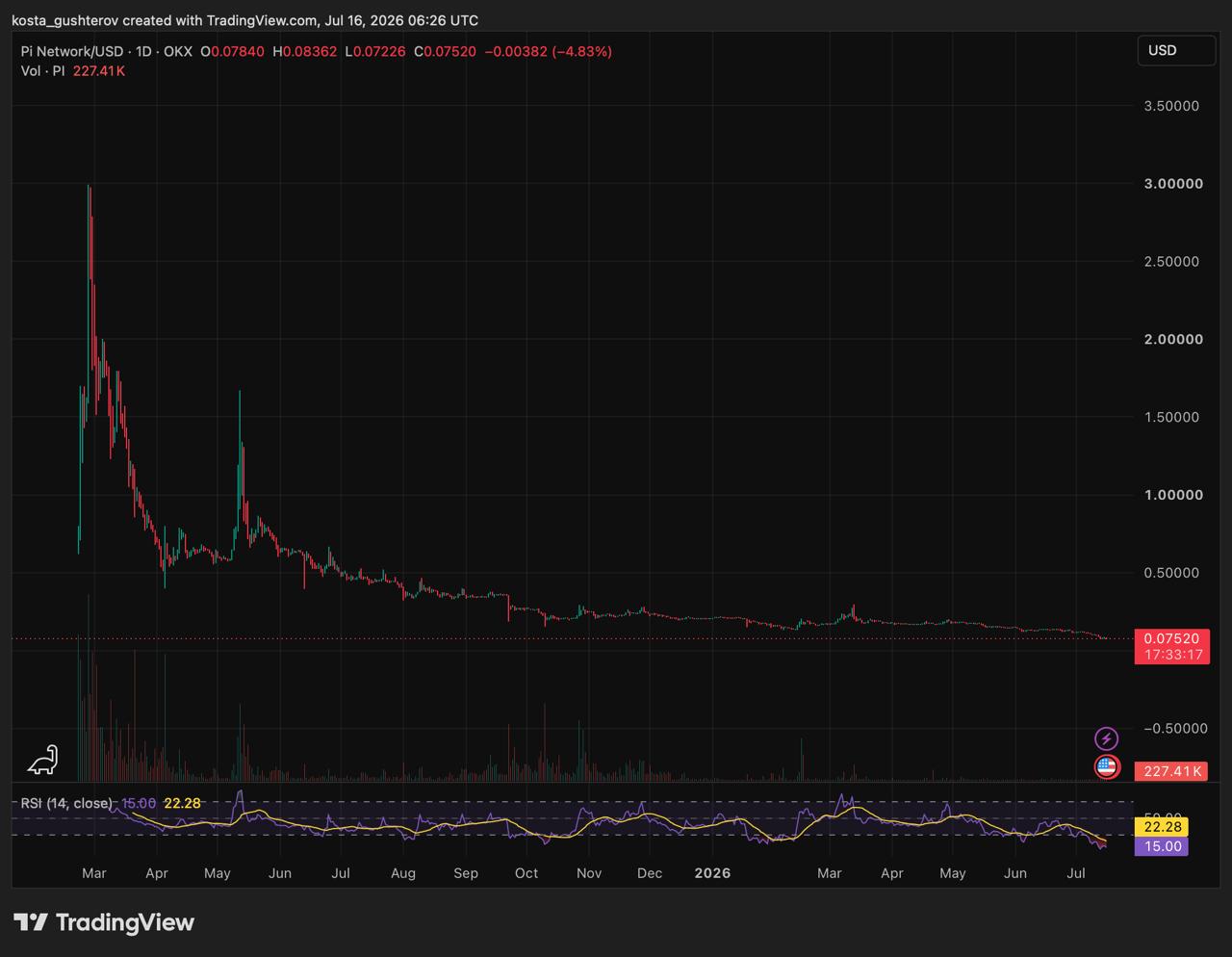
The daily chart shows a persistent sequence of lower highs and lower lows rather than a single capitulation event. Brief rebounds in May 2025 and March 2026 failed to change the trend, while volume generally contracted after the initial Open Network listing period.
The daily Relative Strength Index had fallen to approximately 15 on July 16, well below the conventional oversold threshold of 30. That reflects extreme downside momentum but does not establish that a reversal is imminent. Assets can remain oversold when sellers continue to meet limited demand.
Protocol v25 has also failed to produce an immediate “buy the upgrade” reaction. PI was down approximately 4.8% on the chart’s current daily candle despite the announcement, suggesting traders are treating the release as a backend improvement rather than a near-term economic catalyst.
Why Pi Still Lacks Market Momentum
The central problem is not the absence of development. Pi has launched Open Network, expanded App Studio, introduced persistent backend storage for new applications and continued upgrading its node infrastructure. The difficulty is converting those releases into measurable demand for the token.
Four structural issues help explain the weak response.
Development Has Not Yet Produced a Clear Token Sink
Protocol v25 makes applications easier to build, but using its cryptographic functions does not necessarily require investors to hold large amounts of PI. A durable demand mechanism would need recurring transactions, application fees, merchant payments, collateral usage or another activity that consistently removes available supply from the market.
Pi App Studio recently added persistent storage and AI-assisted planning, allowing developers to create applications that retain user data between sessions. That improves product quality, but the economic question remains whether those applications attract paying users rather than only creators experimenting with the tools.
Mainnet Migration Can Expand Tradable Supply
Pi has a maximum supply of 100 billion tokens, with 65% allocated to community mining rewards and 20% to the Core Team. Its official migration plan continues moving verified balances from the mining app onto Mainnet.
OKX reported a circulating supply of approximately 10.94 billion PI on July 16. Continued migrations increase the number of tokens that can potentially enter exchanges, although migrated coins are not automatically sold and some remain subject to user-selected lockups.
The resulting structure creates a supply test: additional PI can become liquid as more users complete migration, while demand must expand fast enough to absorb holders who mined tokens over several years and may have little or no acquisition cost.
“More Pi on Mainnet also means more engagement and stability in the ecosystem.”
Pi’s founders made that argument before Open Network launched. The price decline shows that migration alone is insufficient; stability depends on migrated users spending, locking or deploying their PI rather than predominantly treating liquidity as an exit opportunity.
A Large Community Is Not the Same as Onchain Demand
Pi describes its community as more than 60 million engaged Pioneers, but that figure measures engagement with the broader Pi application rather than daily buyers, active Mainnet wallets or fee-paying blockchain users.
The distinction matters for valuation. A social network can have a large registered audience without creating proportional demand for its native asset. The market is likely to place more weight on repeat transactions, merchant settlement, application revenue and active wallet retention than on cumulative downloads or daily mining check-ins.
The Forward Roadmap Is Harder to Price
Pi’s official roadmap is now labeled a historical reference and is no longer maintained following the transition to Open Network. The team directs users toward individual announcements instead of publishing an updated sequence of future milestones.
That reduces visibility around Protocol v26, smart-contract deployment, application launches and the timing of deeper DeFi functionality. Pi has told node operators to stay tuned for v26, but the Protocol v25 announcement does not specify which commercial features the next upgrade will activate.
Markets generally assign higher value to development pipelines when milestones, dependencies and implementation dates are visible. An upgrade-by-upgrade communication model makes it harder to estimate when infrastructure work will begin generating material network activity.
The App Redesign Addresses Usability, Not Token Economics
Alongside Protocol v25, Pi has redesigned the mining app’s side menu and profile page. The changes make balances, Pioneer information and ecosystem features easier to locate, beginning a broader refresh of an interface used by the project’s mobile community.
Better navigation can reduce friction and direct more users toward applications. It does not independently solve the demand problem. The redesign becomes economically meaningful only if easier discovery produces more transactions, merchant activity or sustained use of Pi-based services.
What Would Show the Upgrade Is Creating Value
The July 22 activation should first be judged operationally. Node operators must install compatible software to remain connected, and the network needs to complete the transition without prolonged downtime, consensus disruption or synchronization problems.
The more important evidence will emerge after the upgrade:
- Developers launch working zero-knowledge applications.
- Active Mainnet wallets grow beyond migration activity.
- Application transactions and economic volume increase.
- More PI is spent, locked or used as collateral.
- Price reclaims broken levels on rising volume.
From a market perspective, a return above the former breakdown area around $0.10 would be an initial improvement, particularly if accompanied by stronger volume. It would not reverse the long-term trend, but it would show that buyers are responding to the upgrade rather than allowing every rebound to produce another lower high.
Failure to generate application usage would leave Protocol v25 as a successful infrastructure release with limited impact on PI’s economics. The technology can make privacy-preserving identity and compliance applications more efficient; only adoption can turn those capabilities into persistent demand.
Pi Network’s problem could therefore be not that development has stopped. The project is upgrading a functioning network and widening its developer toolkit. The unresolved issue is whether its large mobile community can become an active blockchain economy before migration-driven liquidity and exhausted market confidence keep PI trapped under its post-launch lows.
The information provided in this article is for educational purposes only and does not constitute financial, investment, or trading advice.
The post Pi Network Sets v25 Upgrade With PI 97% Below Peak appeared first on Coindoo.
Source: https://coindoo.com/pi-network-sets-v25-upgrade-with-pi-97-below-peak/


More Crypto News
Check our Market Overview
Disclaimer: This article is for informational purposes only and does not constitute financial advice. Always conduct your own research (DYOR).