
Key Takeaways Lee sees no need to sell BitMine’s core ETH holdings. Staking rewards could be sold after the 5% […]
The post Would BitMine Ever Sell Its Ethereum? Tom Lee Gives His Answer appeared first on Coindoo.
Key Takeaways
- Lee sees no need to sell BitMine’s core ETH holdings.
- Staking rewards could be sold after the 5% target.
- Lee said BitMine was about 97% of the way there.
- More than 5 million ETH is already staked.
- BitMine may revisit its 5% limit in 2027.
Tom Lee says BitMine has no need to sell ETH
BitMine has bought Ethereum for more than 60 consecutive weeks and is closing in on its goal of owning 5% of the supply. That raises a simple question: once it reaches the target, does the company become a seller?
During a recent Bankless interview, BitMine chairman Tom Lee separated the ETH the company acquired for its treasury from the ETH that treasury earns through staking.
“I think ETH doesn’t need to be sold from our perspective,” Lee said.


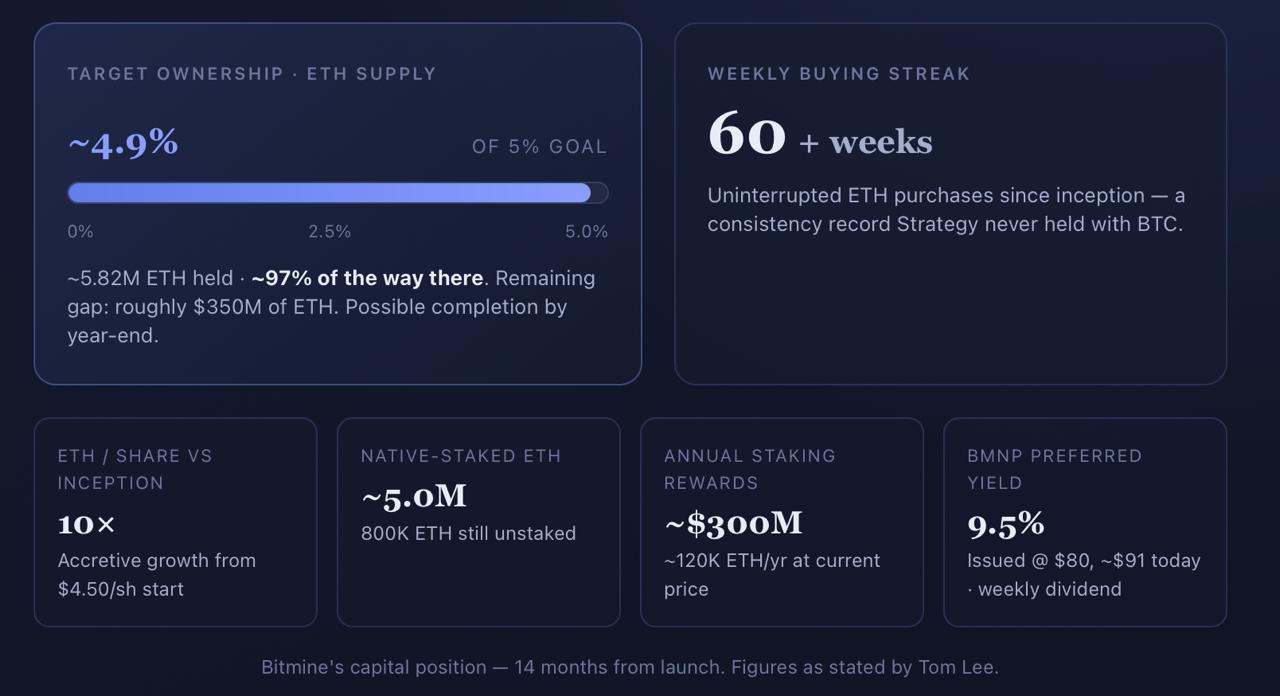
His reasoning is financial rather than rhetorical. Most companies with large asset holdings may eventually need to sell part of them to cover expenses, service debt, or pay distributions. BitMine’s ETH can generate staking income while the company keeps its main position in place. Lee said that income already covers the company’s preferred-stock dividends, reducing the need to sell ETH simply to meet routine obligations.
Lee also said BitMine was not converting its staking rewards into USDC or dollars at the time of the interview. The company’s approach is not just to wait for ETH to rise. It wants the ETH it owns to generate income without reducing the position it has spent more than a year building.
The 5% target creates one possible exception
Lee said BitMine held roughly 5.82 million ETH at the time of the interview, or about 97% of the way toward its goal of owning 5% of Ethereum’s supply. He estimated that another $350 million in ETH purchases would complete the target and said BitMine could get there before the end of 2026.
Reaching 5% would create a practical issue. Staked ETH continues to earn rewards. Even if BitMine stops buying the moment it reaches its target, its holdings could keep growing through those rewards alone.
Lee left room for selling that newly earned ETH. “We would sell the rewards that we’re receiving,” he said while discussing how BitMine might operate after reaching 5%.
That is not a formal commitment to sell a set amount of ETH or a timetable for doing so. Lee described it as one option. He also said BitMine could reconsider whether it makes sense to own more than 5% of Ethereum’s supply when it revisits the issue in 2027.
Everything depends on whether management treats 5% as a firm ownership cap. If it does, selling some staking rewards would help the company stay near that level. If BitMine raises the target, those rewards could remain part of the treasury instead.
Selling rewards is not the same as selling the treasury
Lee’s answer makes more sense once the two types of ETH are separated: the ETH BitMine bought to build its position, and the ETH it earns after staking that position.
Selling the first category would mark a change in strategy. Selling part of the second could be a way to manage the size of the position while preserving the ETH that BitMine accumulated for its long-term treasury.
That distinction matters for investors following large crypto treasury companies. A company selling core holdings to raise cash tells the market something very different from a company using staking income after it has exceeded a preferred allocation.
Staking means BitMine’s holdings can grow even without another purchase. Selling rewards would give the company a way to control that growth instead of allowing its ownership share to rise automatically. It would not necessarily mean Lee had turned bearish on Ethereum or abandoned the treasury strategy.
BitMine wants its ETH to work
Lee said BitMine had native-staked a little more than 5 million ETH, leaving around 800,000 ETH unstaked. Rather than framing that balance as ETH that may be sold, he discussed putting it to work across the Ethereum ecosystem.
The model is straightforward: buy ETH, stake a large portion of it, use the remaining balance carefully, and earn income from the assets already on the balance sheet. That does not remove risk—staking returns and Ethereum’s economics can change, but it explains why BitMine does not describe its ETH as idle inventory waiting for a higher price.
BitMine is also expanding its staking business through Maven. Lee said the platform was already managing more than $2 billion in crypto for clients outside BitMine’s own corporate holdings.
Maven is relevant because it adds to the company’s argument that it can build revenue around Ethereum without selling the ETH at the centre of its treasury. The company is trying to become more than a vehicle that buys and holds ETH; it wants to operate services around the network as well.
The decision after 5%
Lee has repeatedly argued that crypto is entering a more institutional stage. He made a similar case when comparing the sector’s current position with the re-rating of memory stocks in 2024, which he discussed in an earlier interview.
That helps explain BitMine’s approach to Ethereum. The company is treating ETH as a long-term balance-sheet asset that can also produce income, not simply as a trade to close when the price rises.
Lee’s comments still leave an important line open. BitMine does not appear to have a stated plan to sell the ETH it bought for its core treasury. The ETH it earns through staking may be handled differently once the company reaches its ownership target.
If 5% remains the limit, some staking rewards could eventually enter the market. If BitMine decides the limit should be higher, those rewards may keep expanding the treasury. The next decision is not simply whether BitMine sells ETH but whether 5% is enough.
This article is provided for informational purposes only and does not constitute investment advice.
The post Would BitMine Ever Sell Its Ethereum? Tom Lee Gives His Answer appeared first on Coindoo.
Source: https://coindoo.com/would-bitmine-ever-sell-its-ethereum-tom-lee-gives-his-answer/


More Crypto News
Check our Market Overview
Disclaimer: This article is for informational purposes only and does not constitute financial advice. Always conduct your own research (DYOR).