

Key Takeaways Lark Davis says long-held crypto positions should be tested against current alternatives. ADA and Strive shares depend on […]
The post Is Cardano a Better Bet Than Bitcoin Treasury Stocks? appeared first on Coindoo.
Key Takeaways
- Lark Davis says long-held crypto positions should be tested against current alternatives.
- ADA and Strive shares depend on different sources of value and risk.
- Distance from a previous all-time high says little on its own about either asset’s current case.
Crypto YouTuber Lark Davis, known online as The Crypto Lark, has spent several market cycles discussing Bitcoin, altcoins and crypto-linked equities with a large retail audience. In recent podcast, he used Cardano and Strive to challenge a familiar habit: keeping an old position because it has been there for years.
“Every day that you’re holding it, you’re continuing to buy it,” Davis said.
The line captures the useful part of the discussion. A past entry price does not decide whether a position still belongs in a portfolio. The harder question is whether its current thesis still makes sense beside the alternatives available today.


ADA and ASST answer different investment questions
The comparison becomes more complicated once the two assets are separated. ADA is Cardano’s native token, while ASST is a share in a public company that has adopted a Bitcoin treasury strategy.
| Question | Cardano (ADA) | Strive (ASST) |
|---|---|---|
| What is being valued? | A token tied to Cardano’s network, liquidity and ecosystem activity. | Equity in a listed company that holds Bitcoin and raises capital around that strategy. |
| What can move the price? | Network demand, token use, staking, liquidity and broader crypto sentiment. | Bitcoin’s price, Bitcoin held per share, financing conditions and the value investors place on the company. |
| What investors must monitor | Whether Cardano converts development and ecosystem growth into sustained demand for ADA. | Share issuance, debt or preferred claims, and whether new capital increases Bitcoin exposure on a per-share basis. |
The distinction matters because a bullish Bitcoin view does not automatically settle the case for a Bitcoin treasury stock, just as Cardano’s technical development alone does not settle the case for ADA. Each position requires a separate chain of evidence.
Cardano’s current case rests on more than staking
The podcast debate focused heavily on whether Cardano’s use supports its valuation. That question is better approached through a current network snapshot than through a comparison with an earlier bull market.
At the time of writing, CardanoScan showed about 21.45 billion ADA staked, equal to roughly 57.1% of circulating supply. The network also had more than 2,800 registered stake pools and over 126 million confirmed transactions since launch.
Those numbers describe a sizable staking base and a long-running network. The next layer of analysis involves active users, stablecoin liquidity, decentralised-finance activity and whether applications retain demand over time. DeFiLlama’s Cardano dashboard can provide part of that picture, though no single metric can capture an ecosystem on its own.
Cardano’s Bitcoin DeFi push gives investors a current case to follow beyond the announcement itself. At the time of writing, DeFiLlama listed $68.92 million in total value locked on Cardano and $68.25 million in stablecoin market capitalisation. Minswap, with $17.02 million in TVL, and lending protocol Liqwid, with $13.12 million, were the two largest applications by value locked. Those figures establish the current liquidity base; the next test is whether new Bitcoin DeFi products add durable activity and capital rather than simply redistribute what is already on the chain.

A Bitcoin treasury share adds a corporate layer
Strive’s appeal in the podcast came from the prospect that a smaller Bitcoin treasury company could offer more upside than a large, established crypto asset.
The speakers described Strive and Strategy as ways to amplify Bitcoin exposure, which is why the comparison can appeal to Bitcoin-focused investors. Its own treasury dashboard reported 29,462 BTC held as of October 2, putting Bitcoin at the centre of the company’s equity story.
Yet the company’s share price also reflects how that Bitcoin position is financed. In a filing covering the period from April 1 to May 12, Strive said it issued about 3.89 million Class A shares and raised $58.4 million through its sales agreement. The proceeds supported its wider treasury strategy, while the issuance also changed the number of shares through which investors claim that value.
This is why Bitcoin treasury stocks need to be read as companies, not only as Bitcoin proxies. The same balance-sheet pressure has become visible at Strategy, where recent results placed Bitcoin holdings alongside preferred-dividend obligations and common-shareholder outcomes.
Why the 10x comparison stops short
The most tempting part of the podcast comparison is also the least complete: both Cardano and Strive appear to offer substantial upside when measured against previous highs.
The comparison also drew on the contrast between buying Cardano in its earlier cycles and buying it today. That distinction matters, but a previous high still does not explain what would drive a return there.
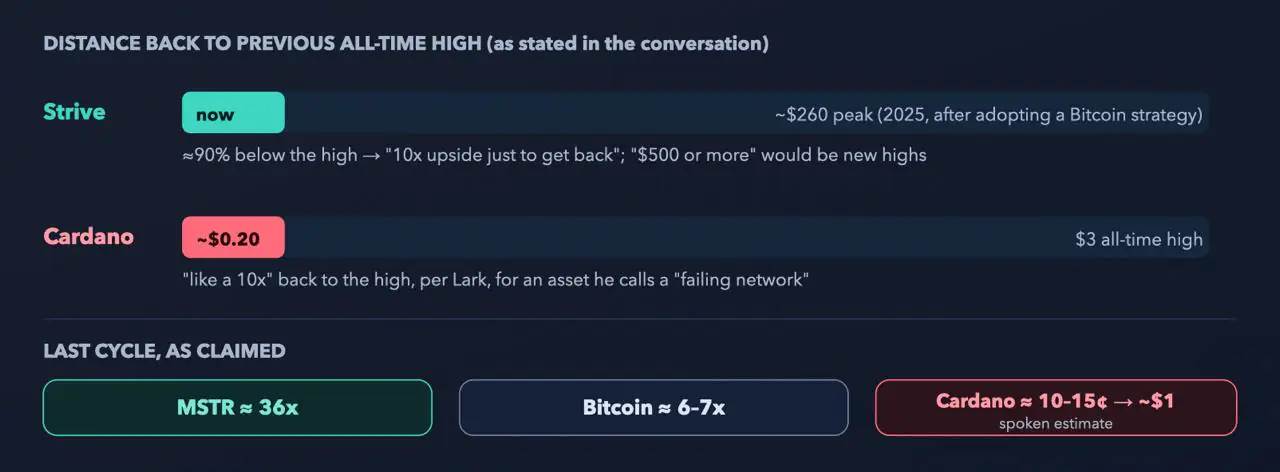
An earlier ADA peak came in a different market cycle, with different liquidity conditions and a different level of adoption across crypto. A previous ASST high needs even more context, because public-company prices can be affected by mergers, stock structure, capital raises and changes in the amount of Bitcoin held per share.
A return to an old level therefore requires more than a positive market. Cardano would need its network activity and token demand to support a stronger valuation. Strive would need Bitcoin exposure, capital allocation and its corporate structure to work in shareholders’ favour at the same time.
That is the gap between a chart comparison and an investment thesis.
The question that follows the podcast debate
Davis’s challenge is useful when it is taken beyond the simple choice between Cardano and Strive. A holder can ask what evidence currently supports the position, what would weaken that view, and whether the asset still fits the role it was originally bought to fill.
For ADA, the focus is whether Cardano can translate network development into durable demand. For Strive, the focus is whether it can grow Bitcoin exposure per share without allowing financing costs or dilution to outweigh that progress.
Both questions depend on current execution. Neither can be answered by an old chart peak alone.
This article is for informational purposes only and does not constitute financial or investment advice. Crypto assets and publicly traded shares carry risk, and past performance does not guarantee future results.
The post Is Cardano a Better Bet Than Bitcoin Treasury Stocks? appeared first on Coindoo.
Source: https://coindoo.com/is-cardano-a-better-bet-than-bitcoin-treasury-stocks/


More Crypto News
Check our Market Overview
Disclaimer: This article is for informational purposes only and does not constitute financial advice. Always conduct your own research (DYOR).