

Key Takeaways March CPI: +3.3% YoY, +0.9% monthly. Headline came in below the 3.4% consensus. Core inflation ex-food and energy: […]
The post March CPI Came in at 3.3%: Here Is What It Means for Bitcoin appeared first on Coindoo.
Key Takeaways
- March CPI: +3.3% YoY, +0.9% monthly.
- Headline came in below the 3.4% consensus.
- Core inflation ex-food and energy: +0.2% monthly, +2.6% annually.
- Gasoline surged 21.2% in March.
- Bitcoin at ~$72K pre-release.
One Number Did Almost All of It
Gasoline rose 21.2% in March. That is the largest single-month jump since the Bureau of Labor Statistics began tracking the index in 1967. It is also almost the entire CPI story. The Hormuz closure that began February 28 restricted one-fifth of global oil and gas supply, and the March gasoline reading is what that restriction looks like when it feeds into the index.
According to US Bureau of Labor Statistics,energy as a whole rose 10.9% for the month. Fuel oil added 30.7%. Together the energy component accounted for roughly three-quarters of the entire monthly CPI increase of 0.9%. The remaining quarter was distributed across shelter at 0.3%, airline fares, apparel, and new vehicles, none alarming in isolation.


Strip out food and energy entirely and core inflation rose 0.2% for the month and 2.6% for the year. That is the reading the Fed has been targeting. The underlying economy is not overheating. One supply shock is.
Why the Market Was Already Expecting This
Bitcoin traders were pricing in a 2.5% move around today’s report, the lowest implied volatility reading since January, per 10x Research report, shared by Coindesk. The market did not fear the number. It was waiting for the interpretation.
The reason is straightforward. The 3.3% headline print came in below the 3.4% consensus estimate, and well under the 3.7% that Morningstar and other Wall Street forecasters had projected. Core, at 2.6% annually and 0.2% monthly, landed at or slightly beneath expectations. This was not a data surprise, it was a confirmation of what markets had already priced in following the Hormuz closure, the oil price surge, and U.S. gasoline prices surpassing $4 per gallon nationally for the first time since August 2022. An energy-driven CPI spike after a major global oil supply disruption is not news. It is arithmetic.

What Actually Matters for Crypto
The CPI number is not the variable. The Fed response is.
Energy-driven CPI prints in 2026 have produced an average immediate drop of 5–8% across major cryptocurrencies, followed by prices reclaiming losses within two to three trading days as markets digest the longer-term implications. The immediate reaction to an elevated headline is algorithmically negative: high inflation reads push the dollar up and risk assets down before any human has parsed the core reading. Bitcoin was trading at $72,000 at the time of publishing the report with the $67K downside zone representing the key liquidation level means that initial move can be sharp.
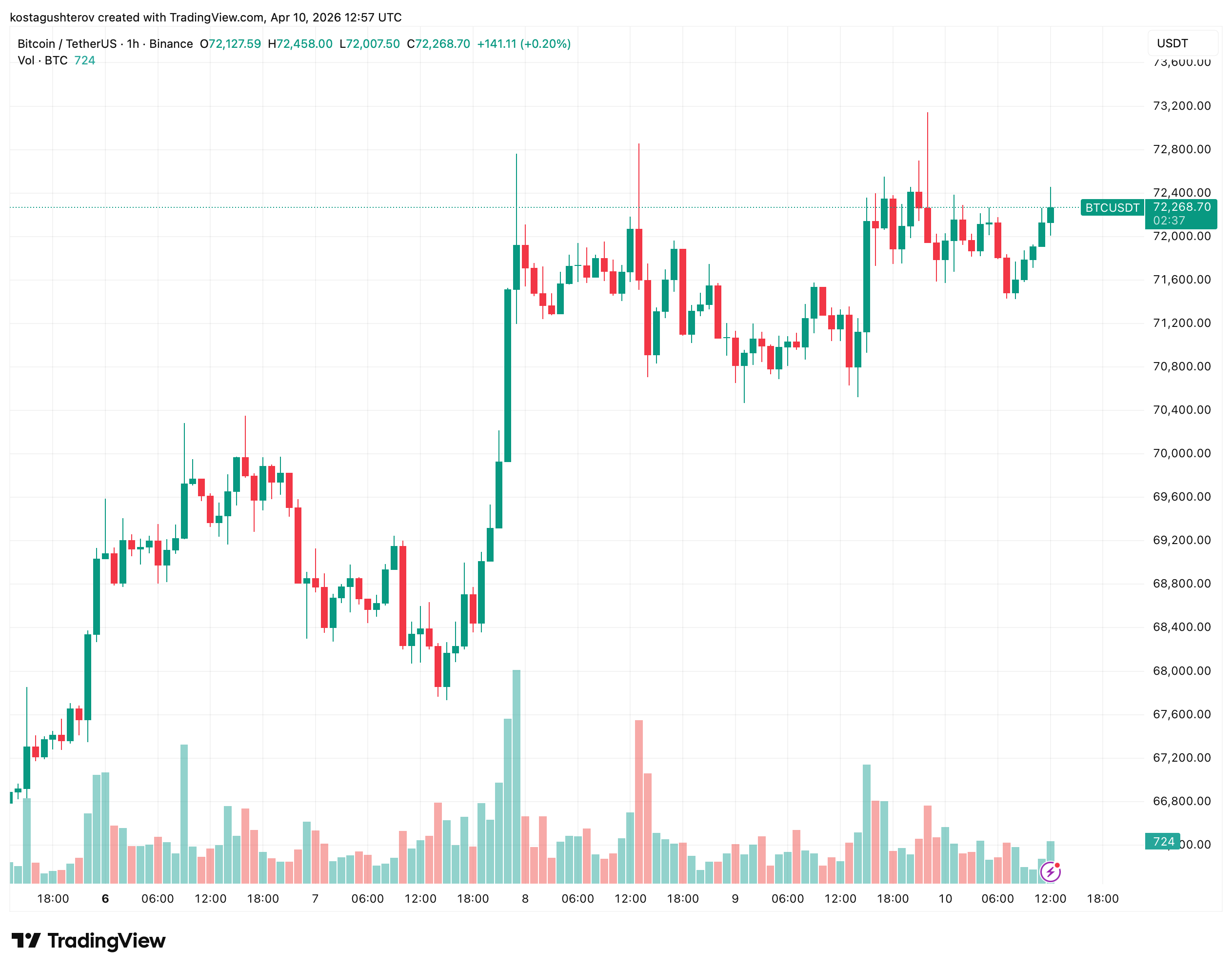
But the two-to-three day recovery pattern holds when the sell-off is driven by a headline rather than a fundamental shift. A CPI spike caused by gasoline, a supply shock from a known war, is not the same signal as broad economic overheating. Core at 2.6% gives the Fed its analytical exit: it can characterize the energy spike as war-driven and transitory, maintain its rate path, and keep cuts on the table without contradicting its own framework.
The scenario where that exit is not taken, where the Fed signals that 3.3% headline inflation changes its calculus regardless of core, is less supported by the current data but carries the most market risk if it materializes. That statement, not the CPI print, is what would genuinely move Bitcoin’s medium-term direction. A sustained hold above $74K on the upside or a breakdown through $67K on the downside would confirm which interpretation the market accepted.
The immediate sell-off, if it comes, is more likely the entry than the trend. The data supports looking through the headline, and a print that landed below even the more aggressive Wall Street forecasts only strengthens that case. Whether the Fed says so out loud is what Bitcoin is actually waiting to hear.
The information provided in this article is for educational purposes only and does not constitute financial, investment, or trading advice. Coindoo.com does not endorse or recommend any specific investment strategy or cryptocurrency. Always conduct your own research and consult with a licensed financial advisor before making any investment decisions.
The post March CPI Came in at 3.3%: Here Is What It Means for Bitcoin appeared first on Coindoo.
Source: https://coindoo.com/march-cpi-came-in-at-3-3-here-is-what-it-means-for-crypto/


More Crypto News
Check our Market Overview
Disclaimer: This article is for informational purposes only and does not constitute financial advice. Always conduct your own research (DYOR).