
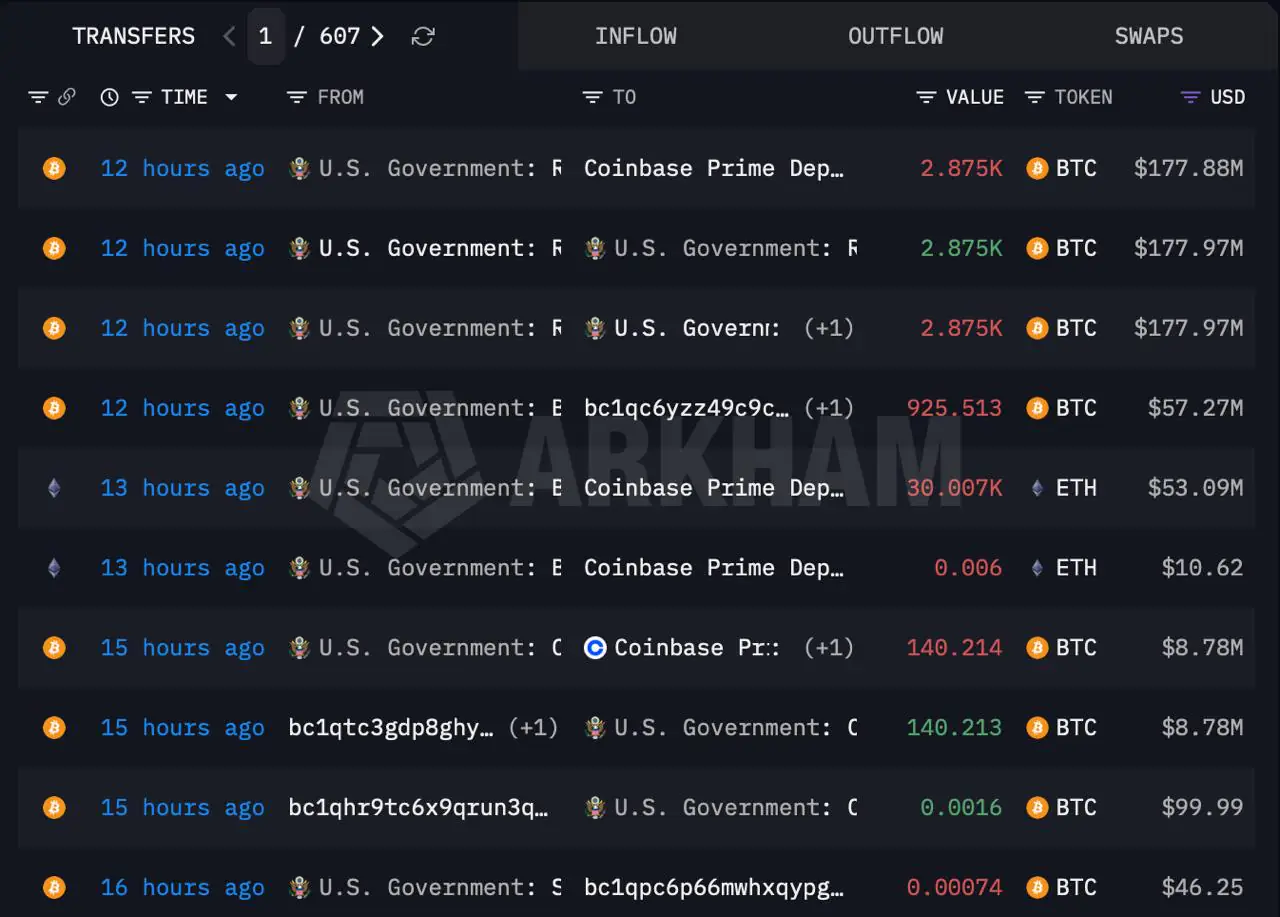
Arkham Intelligence’s on-chain data showed a separate Bitcoin deposit worth around $8.8 million, followed several hours later by a larger […]
The post U.S. Government Moves $297M in Crypto to Coinbase: Sale or Custody? appeared first on Coindoo.
Arkham Intelligence’s on-chain data showed a separate Bitcoin deposit worth around $8.8 million, followed several hours later by a larger batch valued at approximately $288.3 million. Combined, the transfers involved 3,940.7 BTC worth roughly $244 million and 30,007 ETH valued at approximately $53.09 million.
Key Takeaways
- U.S. government-linked wallets deposited 3,940.7 BTC and 30,007 ETH into Coinbase Prime, with a combined value of approximately $297 million.
- The destination does not confirm a sale because Coinbase Prime provides both custody and trading services to the U.S. Marshals Service.
- Bitcoin and Ether face different policy treatment: reserve BTC is subject to a no-sale policy, while non-Bitcoin assets can be managed or disposed of under broader legal authority.
- A liquidation would require further confirmation through official disposition records, identifiable settlement activity, or a documented reduction in government ownership.
Coinbase Prime Deposit Is Not Proof of a Sale
Sending assets to an exchange normally increases the possibility that they could be sold, but Coinbase Prime’s government role makes the destination less conclusive than a standard exchange deposit.
The U.S. Marshals Service selected Coinbase Prime in 2024 to safeguard and trade its large-cap digital assets. The platform therefore functions as both an institutional custodian and an execution venue for federally managed crypto.


The July 13 transfers could represent preparation for a sale, but they could also reflect custody consolidation, wallet reorganization, completion of forfeiture procedures, or the movement of assets into the Marshals Service’s established management infrastructure.
Bitcoin’s route through newly created intermediary wallets does not settle the question. Fresh addresses are commonly used when agencies reorganize custody or separate assets connected to different proceedings. The direct ETH deposit similarly confirms a change in custody location, not an executed trade.
Three Forfeiture Cases Sit Behind the Assets
Arkham’s wallet labels associate the transferred funds with federal cases involving Ryan Farace, assets linked to BTC-e, and cryptocurrency recovered from a wallet controlled by Brian Krewson.
Farace, known online as “XANAXMAN,” was convicted over a darknet narcotics operation. According to the Department of Justice, federal agents seized 2,874.90419597 BTC connected to his drug proceeds in February 2021 and another 58.742155166 BTC in May 2021.
Another portion was associated with BTC-e, the defunct cryptocurrency exchange whose infrastructure was extensively used to move criminal proceeds. Former operator Alexander Vinnik pleaded guilty to money-laundering conspiracy in 2024. The official case record describes BTC-e as a major channel for funds connected to ransomware, hacking, identity theft, narcotics distribution, and other illicit activity.
The Ether originated from a separate narcotics-related forfeiture action. A Department of Justice civil complaint states that law enforcement recovered 30,000 ETH, approximately six additional ETH created through Ethereum hard forks, and several other digital assets from a wallet controlled by Krewson on behalf of convicted traffickers Christopher Castelluzzo and Luke Atwell.
The government valued the property at approximately $31 million when it was seized in July 2022. By the time the civil forfeiture action was filed in November 2023, the wider crypto portfolio was worth more than $54 million.
Bitcoin and Ether Do Not Face the Same Reserve Rules
The most important policy distinction is that the March 2025 executive order does not treat all government-held cryptocurrencies equally.
Under the White House order establishing the Strategic Bitcoin Reserve, Bitcoin that has been finally forfeited, is legally owned by the government and is not needed for specified statutory purposes can be classified as “Government BTC.” Once deposited into the reserve, that BTC must not be sold.
The restriction therefore depends on more than the government controlling the private keys. An asset may still be moving through seizure, forfeiture, victim-compensation, law-enforcement or case-management procedures before it qualifies as reserve Bitcoin.
The executive order also preserves several exceptions. Government digital assets may be disposed of when required by a court, returned to identifiable victims, used for law-enforcement operations, shared with state or local agencies, or released to meet existing statutory obligations.
Ether falls under the separate U.S. Digital Asset Stockpile rather than the Strategic Bitcoin Reserve. The Treasury Secretary is authorized to determine a responsible management strategy for those non-BTC holdings in accordance with applicable law. That creates a clearer legal route for an eventual ETH sale than for Bitcoin already deposited into the reserve.
Pending Legislation Would Create Firmer Boundaries
The executive policy has not yet been converted into a comprehensive statutory framework.
The American Reserve Modernization Act of 2026, introduced as H.R. 8957 on May 21, remains at the introduced stage after being referred to the House Financial Services Committee.
The bill would require the Treasury to establish a Strategic Bitcoin Reserve and a separate Digital Asset Stockpile within 180 days of enactment. Federal agencies would retain temporary custody until the structures were certified as operational, after which their holdings would be transferred to Treasury-controlled facilities within 30 days.
Its treatment of the two asset groups is explicit:
- Bitcoin: Qualifying BTC deposited into the reserve would generally have to be held for at least 20 years and could not be sold, swapped, auctioned, encumbered or otherwise disposed of during that period.
- Other digital assets: The Treasury could sell, exchange or convert non-Bitcoin holdings, provided the proceeds were used to increase the Strategic Bitcoin Reserve or reduce the national debt.
The proposal would also prohibit federal Bitcoin sales during the period before the reserve becomes operational, except for national-security purposes, court-ordered dispositions or the return of assets to verified crime victims.
Because H.R. 8957 has not become law, current agencies are still operating under the executive order, existing forfeiture statutes, court decisions and their own custody procedures. The July 13 transaction exposes the uncertainty created by that unfinished framework.
The Amount Is Smaller Than the Policy Signal
Arkham’s labeled government wallets continued to show roughly $20.5 billion in cryptocurrency and approximately 325,000 BTC around the time of the transfer. The $297 million batch represented about 1.4% of those combined holdings, while the transferred Bitcoin amounted to roughly 1.2% of the government’s identified BTC balance.
A complete liquidation could still add short-term selling pressure, particularly if executed over a narrow period. It would not, however, represent a structural exit from the government’s Bitcoin position or materially change its status as one of the world’s largest known sovereign holders.
The larger issue is whether agencies are using Coinbase Prime principally as a consolidated custodian or as the execution channel for assets that remain legally eligible for sale.
The deposit might be treated as a potential sale signal from some investors until stronger evidence appears.
Confirmation could include:
- An official Department of Justice, Treasury or U.S. Marshals Service disposition notice.
- A court filing authorizing the sale or distribution of the specific forfeited assets.
- An identifiable transfer from Coinbase Prime to a buyer, market maker or settlement wallet.
- A documented reduction in government ownership matched with proceeds or a completed forfeiture distribution.
On-chain monitoring has an important limitation. Because Coinbase Prime combines custody and trading, an internal transaction could be executed without producing an immediate, clearly identifiable blockchain transfer to an outside buyer. The absence of an outgoing transaction would therefore not conclusively prove that the assets remain unsold.
The July 13 movement increases liquidation risk but does not establish that the U.S. government has dumped $297 million batch. Its main significance lies in the unresolved line between routine forfeiture management and implementation of the Strategic Bitcoin Reserve policy—particularly the different legal treatment of BTC and non-Bitcoin assets.
The information provided in this article is for educational purposes only and does not constitute financial, investment, or trading advice.
The post U.S. Government Moves $297M in Crypto to Coinbase: Sale or Custody? appeared first on Coindoo.
Source: https://coindoo.com/us-government-moves-crypto-coinbase-sale-custody/


More Crypto News
Check our Market Overview
Disclaimer: This article is for informational purposes only and does not constitute financial advice. Always conduct your own research (DYOR).