
Key Takeaways Tokenized-asset trading volume on Solana reached $5.8 billion in Q2, rising 114% and led by tokenized equities. Solana […]
The post Tokenized Stocks Boom on Solana as Network Revenue Falls 43% appeared first on Coindoo.
Key Takeaways
- Tokenized-asset trading volume on Solana reached $5.8 billion in Q2, rising 114% and led by tokenized equities.
- Solana retained 32% of spot DEX volume despite a sharp decline in overall trading.
- Network revenue fell 43%, showing that trading growth did not translate directly into greater fee demand.
- SOL investment products attracted capital while staking income remained heavily dependent on token issuance.
Solana ended the second quarter with two very different stories. Trading in tokenized assets on the network more than doubled to a record $5.8 billion in quarterly volume, but overall decentralized exchange activity, lending and revenue generated from network use all declined.
The contrast is not necessarily contradictory. Tokenized-asset volume measures how much tokenized financial exposure changed hands on Solana’s exchanges, while total DEX volume, lending and Real Economic Value show how much of the network’s activity converted into fees and borrowing demand.
Together, the figures suggest that Solana’s capital-markets ecosystem expanded faster than the revenue the network earns from it.


Tokenized Equities Became Solana’s Main Growth Story
Tokenized-asset trading volume increased by 114% quarter over quarter and set a record for a sixth consecutive quarter, according to Blockworks Advisory’s Q2 2026 Solana Tokenholder Report. The report was commissioned by the Solana Foundation, which may provide input on its content, although Blockworks Advisory states that it retains editorial control. That funding relationship is worth keeping in mind when weighing the report’s framing, even where the underlying data is verifiable.
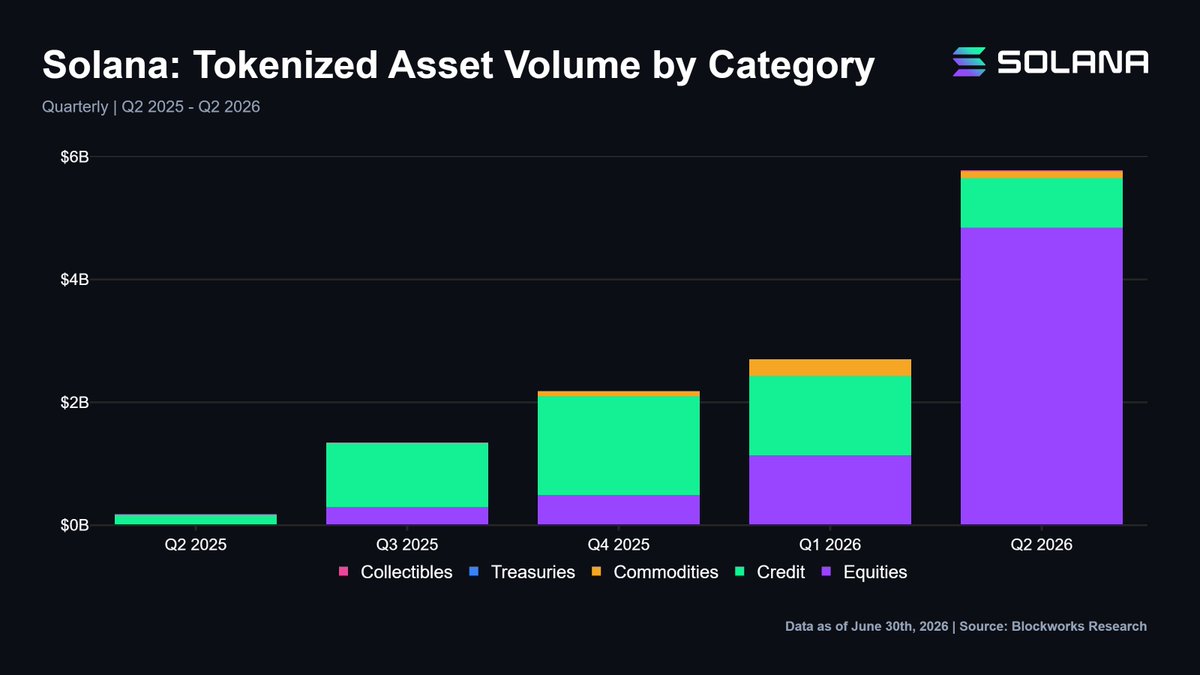
The $5.8 billion figure describes trading volume, not the market value of assets held on Solana and not revenue earned by the network. It measures how much tokenized exposure was bought and sold through Solana’s decentralized exchanges during the quarter.
Tokenized equities dominated that activity with $4.8 billion, or 84% of the total, roughly four times their Q1 volume. The report estimates that Solana now processes approximately 97% of tokenized-equity trading across all blockchains. June alone contributed $3.3 billion of equity volume, a surge catalyzed by the tokenized listing of SpaceX following its June 12 public offering. Private credit added $803 million, with smaller contributions from commodities and collectibles.
The market continued expanding after the quarter ended. On July 10, 2026, tokenized exposure to SK Hynix went live on Solana through Backpack Securities, xStocks and Ondo Finance.
Those products provide similar economic exposure through different legal, custody and redemption structures. That distinction matters because tokenized assets are not a single standardized product category. As our guide to RWA tokenization platforms explains in detail, investors still need to examine who issued each token, what backs it, whether it can be redeemed and which users are eligible to hold it.
Solana Kept Its DEX Lead as Trading Slowed
Solana decentralized exchanges processed $160.8 billion in spot volume during Q2. That was down 44% from $288.5 billion in the previous quarter, but the network still handled approximately 32% of spot DEX volume across the blockchains measured.
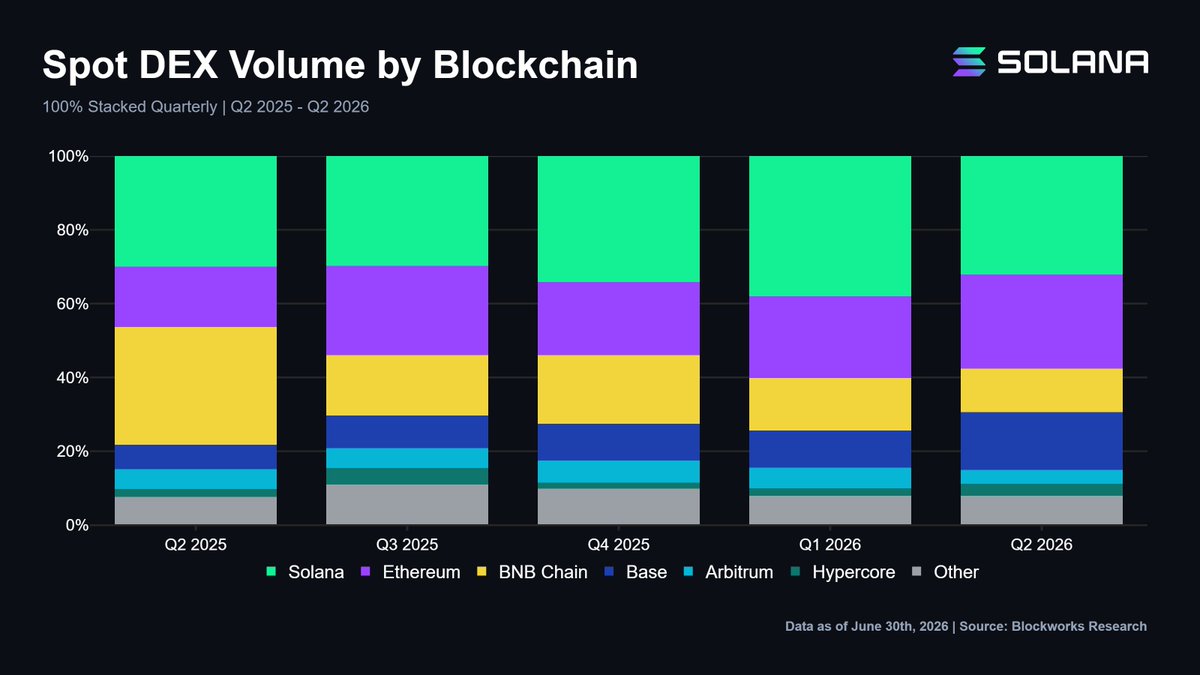
Ethereum followed with 25%, while Base and BNB Chain accounted for 16% and 12%, respectively. Q2 was the eighth consecutive quarter in which Solana controlled more than 30% of the measured spot market.
This combination requires context. Solana did not lose its relative position against competing networks, but the overall market became less active. Maintaining market share in a contracting market is different from generating absolute growth. The monthly path was more constructive than the quarterly total: volume fell from $52.3 billion in April to $48.0 billion in May, then rebounded 26% to $60.5 billion in June as tokenized-asset activity accelerated.
Application revenue also fell 31% to $228.4 million. Perpetual futures presented a different picture, with notional volume increasing 60% quarter over quarter to $183 billion, but that recovery did not offset weaker activity across the rest of the ecosystem.
The composition of that revenue also complicates the diversification story. Pumpfun, the memecoin launchpad, remained the ecosystem’s largest business with $90.1 million, or 39% of all application revenue, and accounted for 97% of launchpad revenue. Tokenized equities may be the growth story, but the single biggest earner on Solana is still the speculative category the network is described as moving beyond. That concentration reached a new high in Q2 precisely because the rest of the market shrank faster.
Network Revenue Fell Faster Than Market Share
Solana’s Real Economic Value, or REV, totaled $51 million in Q2, down 43% from the previous quarter. REV measures transaction fees and out-of-protocol tips paid by users while excluding inflationary token issuance.
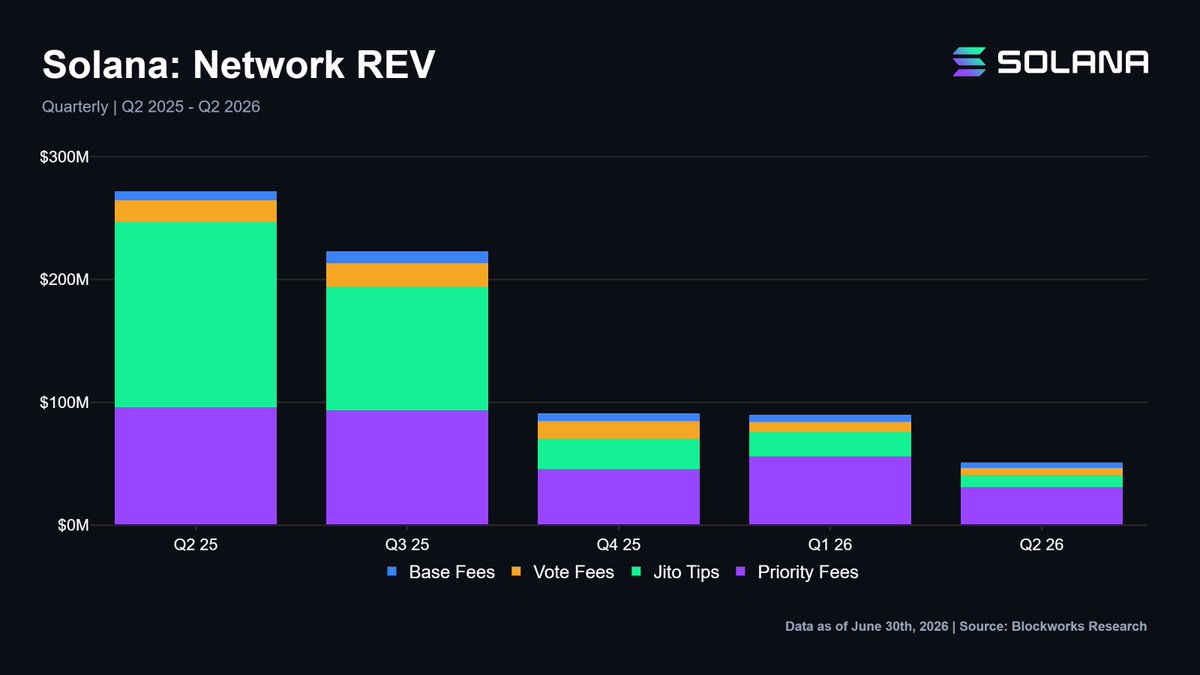
Monthly REV declined from $18.6 million in April to $18.1 million in May and $14.3 million in June. Priority fees fell 45% to $30.8 million, while Jito tips dropped 50% to $9.9 million. Base and vote fees contributed another $10.3 million.
The decline also cost Solana relative position among blockchains. The report ranks Solana fourth in quarterly network revenue with a 12% share, behind Hyperliquid at 33% with $141.4 million, Tron at 21% and Ethereum at 15%, down from Solana’s 18% share in Q1. Hyperliquid’s lead rests on the trading-fee engine we examined in our analysis of the platform’s $1.2 billion in cumulative fees. The comparison is uncomfortable for Solana’s economics: a network processing billions of transactions earned roughly a third of what a single derivatives-focused chain collected in the same quarter.
Solana still processed 9.8 billion non-vote transactions during the quarter, with a median transaction fee near $0.0004. However, 27% of those transactions reverted, a share the report attributes to automated arbitrage strategies and describes as a feature rather than a bug. That characterization is the report’s reading, not a settled fact. Daily active addresses also fell from 2.4 million in Q1 to 2.0 million, meaning the network processed nearly as many transactions from a noticeably smaller user base. The network remained heavily used, but high transaction counts did not automatically produce high revenue because individual transactions remained extremely inexpensive.
Lending Has Not Followed Tokenization Higher
Deposits across Kamino and Jup Lend ended the quarter near $4.1 billion, while outstanding loans stood at approximately $1.6 billion. Deposits declined 8.3%, and loans fell 7.9%.
The pullback was more pronounced in real-world asset lending. Deposits connected to RWA markets dropped from $1.23 billion in Q1 to $640 million in Q2, a decline of 48%.
This exposes an important gap in the tokenization narrative. Solana can host record trading in stocks, credit products and funds without those assets immediately becoming widely used as collateral or generating substantial borrowing demand.
A stronger confirmation of adoption would involve tokenized-asset growth occurring alongside expanding collateral use, higher borrowing demand and deeper secondary-market liquidity. Q2 delivered the first part, but not the others.
Staker Income Still Came Mostly From Inflation
SOL’s nominal staking yield ended the quarter near 5.5%, down from 5.8% at the end of Q1. With inflation around 3.8%, the estimated real staking yield was approximately 1.7%.
Stakers earned $487 million during Q2, down 23% from $630 million in the previous quarter. More than 98% of that revenue came from token issuance, while Jito tips contributed roughly $8.2 million.
This means staking rewards continued to depend primarily on newly issued SOL rather than fees generated by network activity. For long-term token economics, the balance between issuance, fee income and token burning is more informative than the headline staking percentage alone.

The Proposed Burn Increase Is Not Yet Active
The report estimated that SIMD-553 could burn between 7,500 and 9,000 SOL per day under current activity assumptions, roughly ten times the existing rate and equivalent to around 12% to 15% of daily issuance.
That is a modeled scenario, not the current burn rate or a guaranteed outcome. SIMD-553 remains a proposal and would need to pass the necessary governance and implementation stages before changing SOL’s supply dynamics.
Under Solana’s current fee structure, 50% of the base transaction fee is burned. The remaining half and all priority fees are paid to the validator producing the block.
A larger burn could strengthen the connection between network activity and SOL demand, but it would not automatically make the token deflationary. Even the report’s estimated burn remains below total daily issuance.
Investment Products Attracted Capital Through the Downturn
SOL spot investment products recorded approximately $120 million in net inflows during Q2, extending positive flows for a third consecutive quarter. Over the same period, Blockworks data showed $3.7 billion of outflows from Bitcoin products and $500 million from Ethereum products.
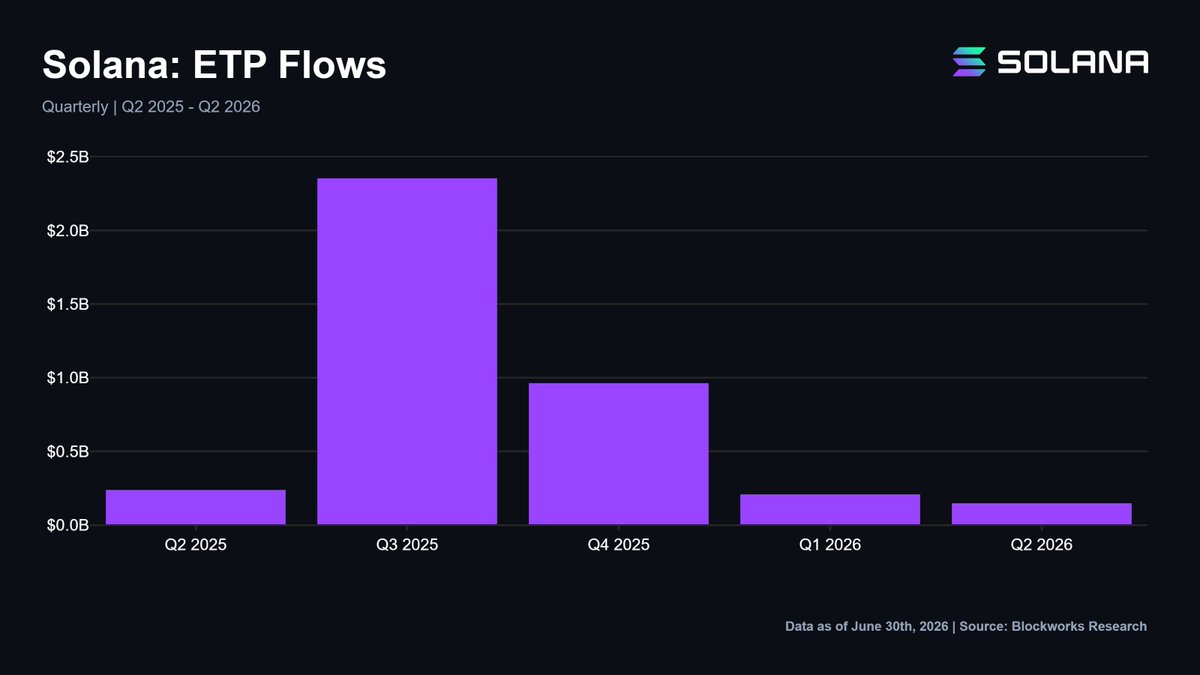
The comparison should be treated carefully because the products differ substantially in size, age and investor base. Still, the direction of flows suggests that some investors continued building regulated Solana exposure despite weaker onchain revenue and lower market activity.
Official SEC filings confirm the expansion of that investment infrastructure. The Grayscale Solana Staking ETF trades on NYSE Arca under GSOL, while the 21Shares Solana ETF trades on Cboe BZX under TSOL. The pipeline is still growing: Morgan Stanley filed a third round of SEC amendments on July 14 for spot Ethereum and Solana ETFs expected to trade under MSSE and MSOL. Traditional financial institutions are building similar infrastructure on other networks as well, as we covered in out report on JPMorgan’s tokenized money market fund.
Positive fund flows do not guarantee higher SOL prices or stronger network revenue. They show demand for regulated exposure, which is separate from activity taking place inside Solana applications.
What Solana’s Q2 Results Actually Show
Q2 was not simply strong or weak. Solana gained ground as infrastructure for trading tokenized assets and retained its lead in decentralized spot trading, but the network generated less revenue and experienced weaker lending demand.
The constructive interpretation is that Solana is broadening beyond the speculative activity that powered its earlier revenue peaks. The more cautious interpretation is that tokenized-asset growth has not yet translated into enough borrowing, trading intensity or fee generation to strengthen the network’s underlying economics, that the user base contracted during the quarter, and that the largest single source of application revenue remains a memecoin launchpad.
The next confirmation would come from several metrics improving together: continued tokenized-asset growth, recovering REV, greater use of tokenized securities as collateral, sustained investment-product inflows and a larger share of staking rewards funded by actual fees instead of issuance.
Until then, Solana’s institutional expansion is real, but the economic value captured by the network remains the part that still needs to catch up.
Source review: Q2 figures were checked against Blockworks Advisory’s Q2 2026 Solana Tokenholder Report, which was commissioned and funded by the Solana Foundation, with Blockworks Advisory stating it retains editorial control. Recent developments were reviewed against Solana Foundation publications, Solana’s technical documentation and SEC filings as of July 21, 2026. Coindoo has no commercial relationship with any entity mentioned.
This article is provided for informational purposes only and does not constitute financial or investment advice.
The post Tokenized Stocks Boom on Solana as Network Revenue Falls 43% appeared first on Coindoo.
Source: https://coindoo.com/tokenized-stocks-solana-network-revenue-falls/


More Crypto News
Check our Market Overview
Disclaimer: This article is for informational purposes only and does not constitute financial advice. Always conduct your own research (DYOR).