
Key Takeaways Seventy percent of surveyed US crypto traders are open to some form of autonomous AI portfolio management. Full […]
The post US Crypto Traders Want AI-Managed Portfolios – Are They Ready? appeared first on Coindoo.
Key Takeaways
- Seventy percent of surveyed US crypto traders are open to some form of autonomous AI portfolio management.
- Full autonomy is more popular among younger traders than older respondents.
- OKX and eToro already provide tools that allow compatible AI agents to execute trades.
- Robinhood has launched agentic stock trading and plans to expand the model to crypto.
- The survey measures willingness to use AI, not whether AI-managed portfolios perform better.
An OKX survey of 1,400 US crypto traders found that 70% would be comfortable with AI managing a portfolio either fully or within limits set by the user.
That result does not mean seven in ten traders are ready to give an algorithm unrestricted access to their savings. It includes people willing to allow automated trading only after defining the available capital, supported assets and acceptable risk.
The finding is still significant because crypto platforms are already building the infrastructure needed to move AI from analysis into execution. OKX and eToro support agent-enabled trading tools, while Robinhood has launched agentic accounts for traditional securities and announced a planned expansion into crypto.
What the 70% Result Actually Means
AI portfolio management can describe very different levels of control.
At the lowest level, a chatbot may summarize market news or explain why a position moved. The user still makes every decision and manually places each order.
An approval-based agent can go further by preparing a trade, calculating the position size and waiting for confirmation. A limited autonomous agent may execute automatically, but only within rules such as a maximum budget, a list of permitted assets or a ban on leverage.
Full autonomy gives the system more freedom to select and execute strategies without transaction-level approval.
| Type of AI Use | What the System Does | What the User Controls |
|---|---|---|
| Research assistant | Summarizes news, market data and portfolio risks | The user chooses and places every trade |
| Approval-based agent | Builds an order or strategy for review | Each transaction requires confirmation |
| Limited autonomous agent | Trades automatically within preset conditions | Budget, supported assets and risk limits |
| Fully autonomous agent | Chooses and executes strategies without individual approvals | The initial mandate and the ability to disconnect access |
The OKX headline figure covers the final two categories. It shows that most respondents are open to automated execution, but not that they all support completely unsupervised trading.
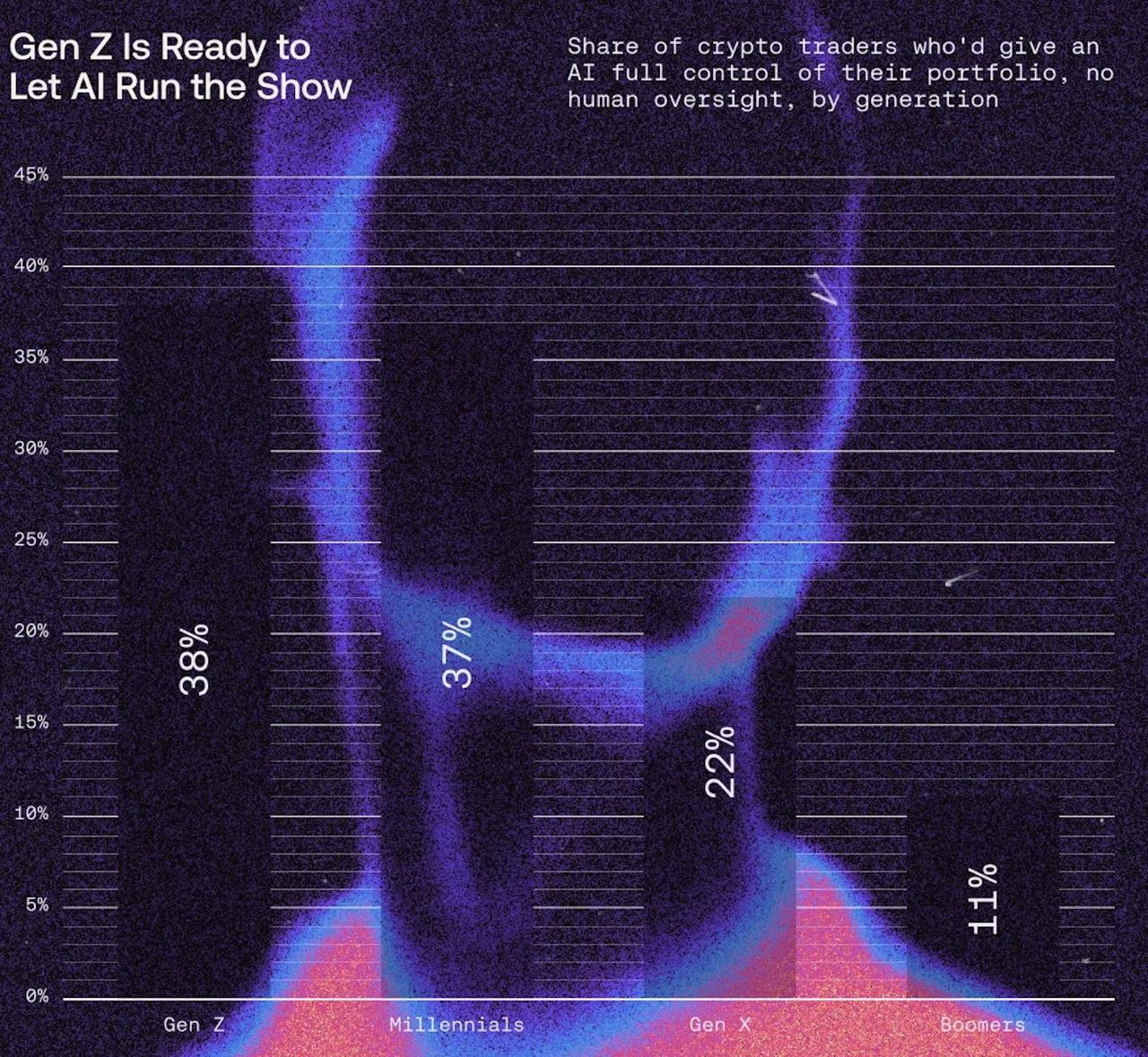
The age divide becomes clearer when full autonomy is considered separately. 38% of Gen Z respondents and 37% of Millennials said they would allow an AI to operate without direct supervision. Only 11% of Boomers gave the same answer.
A quarter of Gen Z and Millennial respondents also said they trusted an AI-generated trading recommendation more than advice from a human adviser. The share among Gen X and Boomer respondents was roughly half as large.
AI Is Already Part of Crypto Research
The move toward automated execution follows a broader change in how traders gather information.
Fifty-one percent of respondents said they use AI for research or trading several times a week. Another 77% had used a general-purpose chatbot to investigate a crypto position during the previous three months.
Research is a relatively low-risk entry point. A trader can compare an AI-generated answer with a price chart, company announcement or regulatory filing before acting.
Connecting the same system to an exchange account changes the consequences. A misunderstood instruction or incorrect parameter can become a real position within seconds.
This is also what separates newer AI agents from many traditional trading bots. A conventional bot normally follows rules written in advance. An AI agent can interpret a broader instruction, decide which tools to use and adapt its response as new information becomes available.
That flexibility may make the system easier to use, but it also creates more room for unexpected behavior.
OKX Already Supports Agent-Executed Crypto Trades
OKX is not only measuring interest in autonomous trading. It has already released infrastructure that allows compatible AI agents to interact with an exchange account.
The OKX Agent Trade Kit can provide market information and support spot, futures, options and advanced order execution through natural-language instructions.
Depending on the permissions granted, an agent can inspect balances, monitor positions, place or amend orders and establish stop-loss or take-profit levels. It can also run automated approaches such as dollar-cost averaging or grid strategies.
Users do not need to begin with live funds. OKX supports simulated trading and read-only access, allowing the system to inspect account information without placing orders.
The exchange recommends using a separate sub-account and limiting it to the amount intended for the strategy. It also warns that models may misunderstand instructions, rely on outdated information or execute during periods of poor liquidity and high slippage.
The AI may decide what to do, but the account permissions determine what it is capable of doing.
Robinhood Plans to Bring the Model to Crypto
Robinhood launched Agentic Trading accounts in May 2026, initially supporting equities before adding options.
Customers can connect a third-party AI model to an account reserved for agent activity. The system can access only the capital placed inside that account, rather than the customer’s entire portfolio.
Users can monitor trades, follow profit and loss, receive activity notifications and disconnect the agent.
Robinhood later announced that it was preparing Agentic Accounts for crypto trading. The planned feature would allow eligible US customers to connect an AI model to Robinhood’s crypto data and trading tools.
The company described crypto support as an upcoming rollout, so it should not be treated as universally available yet.
Robinhood also makes clear that third-party agents are not supervised or guaranteed by the platform. Customers remain responsible for reviewing the activity and losses generated through the connection.
eToro Gives Each Agent a Separate Portfolio
eToro introduced Agent Portfolios through a gradual rollout in March 2026.
The feature allows an investor to create a dedicated portfolio, assign it a budget and connect an AI through an API key restricted to that portfolio.
The agent can inspect balances and open or close positions within the funds assigned to it. eToro lists scheduled rebalancing, theme-based portfolios and strategies responding to external signals among the possible uses.
This account design appears across several early agentic trading products. Instead of connecting an AI to everything an investor owns, platforms place it inside a smaller area where its maximum direct exposure is easier to define.
The Most Important Feature May Be the Off Switch
When OKX asked what would make respondents trust an AI agent with payments, the most common answer was not a higher projected return or a more advanced model.
Traders prioritized real-time notifications and the ability to revoke permissions immediately. That answer was selected more than twice as often as any alternative and remained popular across age groups.
The result suggests that users may accept automated decisions as long as control remains reversible.
- A capital limit restricts how much money the agent can reach.
- Product restrictions can prevent access to leverage, withdrawals or unsupported assets.
- Approval rules can stop higher-risk orders from executing automatically.
- Live alerts make unexpected activity easier to identify.
- Immediate revocation allows the user to disconnect the system before more trades are placed.
The same issue will extend beyond investment accounts as AI agents begin paying for services and completing transactions independently. Our analysis of how stablecoins could become a payment rail for AI agents explains why budgets, permissions and revocation controls may become central to the wider agent economy.
The Survey Measures Confidence, Not Performance
OKX also asked respondents about AI-generated trading recommendations they had already followed. Fifty-five percent described the outcome as successful, 41% called it mixed and 4% said it had backfired.
Those results are based on personal assessments rather than verified portfolio returns. They were not compared with Bitcoin, a market index or a passive strategy, and different respondents may define a successful recommendation differently.
The published survey page also does not disclose how participants were recruited, when the fieldwork took place, whether the sample was weighted or what margin of error applies.
The findings are therefore useful for measuring interest in AI trading tools. They do not show that AI-managed portfolios outperform human traders or established automated strategies.
Regulators Are Examining How AI Is Presented and Controlled
Automated investment tools, AI technologies and trading algorithms appear in the US Securities and Exchange Commission’s 2026 examination priorities.
The SEC said examinations may consider whether statements about AI capabilities are accurate, whether a system operates consistently with its disclosures and whether automated recommendations remain appropriate for an investor’s profile or stated strategy.
For supervised financial firms, using a third-party model does not remove the need for controls. Regulators may still examine how the product is described, what the agent is allowed to do and whether customers understand the authority they have granted.
Interest Is Growing Faster Than the Track Record
The OKX survey points to clear demand for AI tools that can act rather than simply advise. The launches from OKX and eToro show that this is no longer a theoretical product category, while Robinhood’s planned crypto rollout could bring the model to a wider retail audience.
What remains missing is a long and comparable performance record across different market conditions.
Crypto trades continuously and produces large amounts of real-time data, making it a natural testing ground for AI agents. Those same characteristics also allow a flawed strategy to keep operating while the account holder is offline.
The early products are therefore being built around limited autonomy rather than unlimited access. The agent may research, monitor and execute, but the investor still decides how much capital it can reach and how quickly that access can be removed.
Whether these tools become widely trusted may depend less on how often an AI finds the right trade and more on what happens when it gets one wrong.
The information provided in this article is for educational purposes only and does not constitute financial, investment, or trading advice.
The post US Crypto Traders Want AI-Managed Portfolios – Are They Ready? appeared first on Coindoo.
Source: https://coindoo.com/us-crypto-traders-ai-managed-portfolios/


More Crypto News
Check our Market Overview
Disclaimer: This article is for informational purposes only and does not constitute financial advice. Always conduct your own research (DYOR).