
Key Takeaways Draft requires approval and a future hard fork. Burn reaches 100% at 60.25 million ETH. Issuance peaks near […]
The post Why Ethereum Could Burn More Rewards as Staking Grows appeared first on Coindoo.
Key Takeaways
- Draft requires approval and a future hard fork.
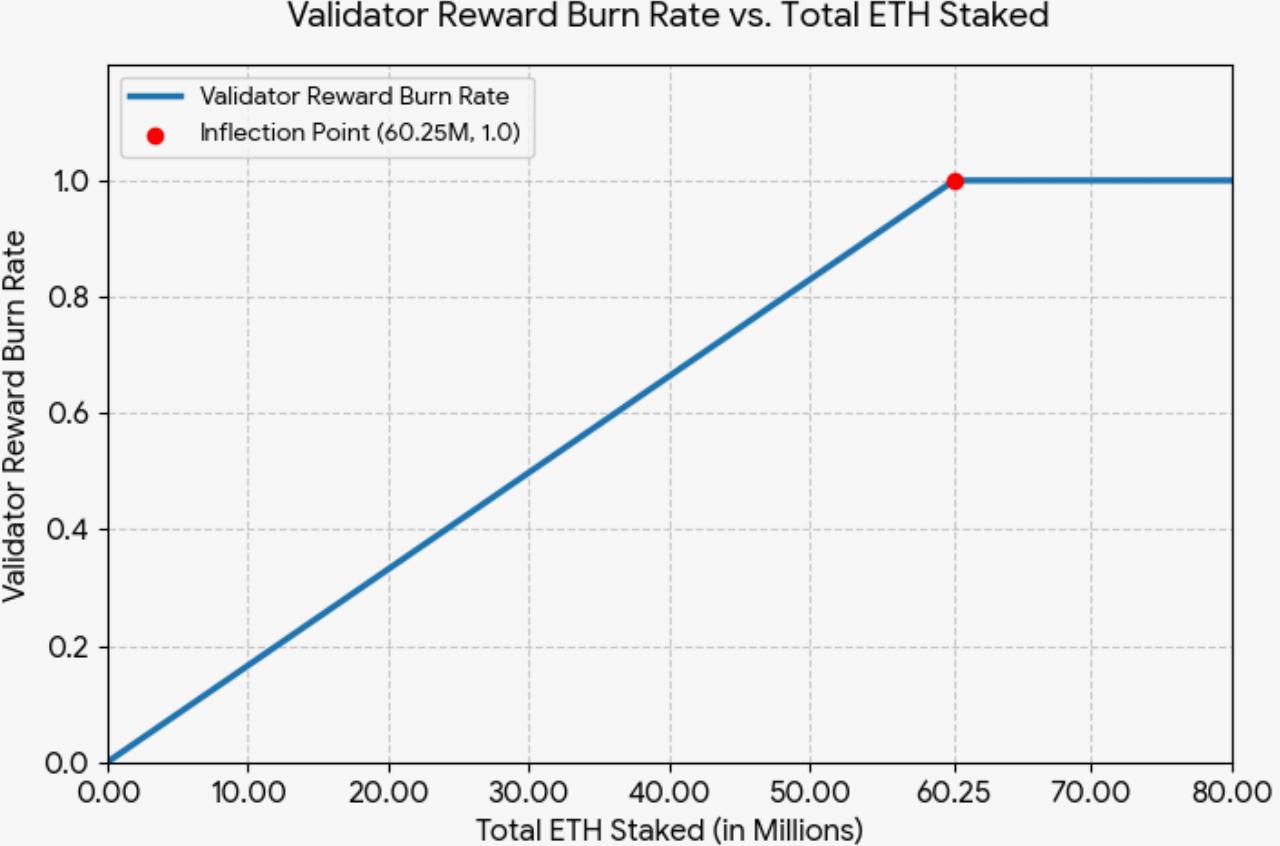
- Burn reaches 100% at 60.25 million ETH.
- Issuance peaks near 20% staking participation.
- Largest operators face weaker incentives to expand.
- Idealised deductions preserve validator performance incentives.
- Lower issuance may reduce unstaked holders’ dilution.
Under draft EIP-8363, called Tapered Issuance Burn, a growing share of validator rewards would be burned as staking participation rises.
At 60.25 million ETH in active stake—a saturation balance designed to represent approximately half of ETH’s supply at activation, the burn would offset 100% of the idealised consensus rewards covered by the mechanism.
The proposal remains a Core EIP draft rather than an approved Ethereum upgrade. It would require a hard fork because it changes Ethereum’s consensus-layer state transition, although no changes to the execution layer or existing smart contracts would be needed. Its technical and economic details may still change, and discussion is continuing on the Ethereum Magicians forum.


The Proposal Would Let Yield Limit Staking Growth
Ethereum’s current issuance curve reduces the return earned by individual validators as more ETH enters staking. However, it never completely removes the financial incentive to add more stake.
According to the proposal, the existing curve retains a yield floor of roughly 1.5% even at extremely high participation. The market can therefore reach an equilibrium only if the return demanded by the next potential validator remains above that floor.
That required return may continue falling as institutional custodians, liquid-staking protocols and professional infrastructure providers reduce the operational, liquidity and technical costs that previously discouraged holders from staking. The trend is already visible in proposed institutional products: Morgan Stanley’s planned Ether trust intends to stake between 50% and 80% of its ETH through external providers if the product launches.
Unstaked holders are also diluted when the protocol creates new ETH for validators. As staking becomes easier, accepting that dilution may become less attractive than moving ETH into a staking service or yield-bearing derivative.
EIP-8363 would allow net consensus yield to keep declining rather than stopping at a protocol-defined minimum. After rewards are calculated through the existing system, a growing portion would be deducted and burned.
Annual consensus issuance would stop rising continuously with the staking ratio. It would peak when approximately 19.8% of ETH is staked and decline as participation moved beyond that level.
60.25 Million ETH Is Not a Staking Cap
The saturation balance is an economic reference point rather than a hard limit. The proposal would not reject new validators, force existing participants to exit or prevent more than 60.25 million ETH from entering staking.
At that balance, the consensus issuance earned by a correctly performing validator from the duties covered by the mechanism would be fully offset by the burn. Validators could still receive execution-layer income from priority fees and maximal extractable value, or MEV.
The authors do not expect the market to reach saturation under ordinary conditions. Validators generally require a positive return to compensate for infrastructure, maintenance, downtime, liquidity restrictions and slashing exposure.
As net yield declines, some participants would stop entering while others could exit. The expected equilibrium would therefore sit below 50%, where the remaining return matches the compensation demanded by the next validator.
High Staking Can Increase Concentration Risks
More stake raises the nominal value exposed to slashing during an attack, but the proposal argues that the additional security benefit becomes progressively smaller as staking participation rises.
A high staking ratio can also move more ETH into exchanges, custodians, liquid-staking protocols and institutional products because many holders cannot or do not want to operate validators directly. Validator power may consequently become concentrated among a limited number of professional operators.
Concentration creates an operational risk beyond the issuance debate. If more than one-third of validators go offline together, Ethereum loses finality until the required two-thirds majority is restored. That makes the network’s 33.3% threshold especially important when validators cluster around the same clients, hosting providers or jurisdictions.
The authors are particularly concerned that a dominant provider could become systemically difficult to slash. If a large operator suffered a major slashing event, its customers could have enough financial and political influence to seek intervention rather than accept the losses.
High participation could also weaken Ethereum’s ability to coordinate against a colluding validator group. Social slashing depends on the wider economy supporting an alternative chain, which becomes harder when a large percentage of ETH is controlled through custodians and staking intermediaries.
The Curve Turns Scale Against Large Operators
The current issuance system continually rewards expansion: an operator that adds validators increases its share of active stake while total issuance also grows with network participation. There is no operator size or staking ratio at which another validator reduces that operator’s consensus income. The tapered burn would change that relationship because, once issuance peaks near a 20% staking ratio, an expanding operator would claim a larger share of a shrinking reward pool.
For the largest operators, the decline in the total reward pool could eventually outweigh the benefit of controlling more validators. The EIP calculates that an operator holding half of all active stake would stop increasing its consensus income through expansion once approximately 31% of the ETH supply is staked.
Smaller operators would reach the same turning point closer to the 50% saturation balance. The mechanism would therefore weaken consensus-layer economies of scale sooner for entities that already control the largest share of stake.
The mechanism would not eliminate every advantage enjoyed by large operators because it would not affect MEV or priority-fee income.
Solo Stakers Face a Different Tax Equation
The proposal’s authors argue that the existing curve creates a separate disadvantage for solo validators. Dilution reduces the real return earned by every staker, while individuals in jurisdictions that tax staking rewards as income may still owe tax on their full nominal rewards.
Some institutional investors and holders using accumulating exchange-traded products, non-rebasing liquid-staking tokens or wrapped tokens may not face the same immediate tax burden. Solo participants could therefore reach negative dilution-adjusted returns sooner, encouraging them to close validators or move their ETH into an intermediary and potentially increasing concentration.
By limiting issuance growth, EIP-8363 attempts to reduce that disadvantage. It would not change tax law or remove the operational benefits enjoyed by professional providers, but it could lower the dilution component that affects solo stakers earlier.
Critics See the Opposite Risk for Solo Stakers
Not everyone accepts the proposal’s argument that lower issuance would reduce the disadvantages faced by solo stakers. Mike Silagadze, co-founder and CEO of ether.fi, argues that the mechanism could produce the opposite result.
In an August 4 post, Silagadze criticised what he described as a 48-hour comment window for a major change to Ethereum’s network economics. He argued that lower rewards could push independent validators out while leaving large centralised operators with lower capital and operating costs in a stronger position.
This is so disappointing on every level.
EIP released with 48 hours notice for comments. Realistically 4 months before it goes live. For a major network economics change with far reaching implications for all of DeFi.
Every builder on Ethereum opposes this. Why is this a focus?… https://t.co/qQbCui8aju
— Mike Silagadze🛡 (@MikeSilagadze) August 4, 2026
Silagadze also warned that declining staking returns could drive capital away from DeFi protocols built around staking and potentially encourage large amounts of ETH to be withdrawn. In his view, that could increase the amount of ETH available to enter the market rather than support its price through lower issuance.
Silagadze’s predictions remain unproven, but they expose the key question facing the proposal: whether lower rewards would weaken large staking operators or leave independent validators unable to compete with them.
Why the Burn Uses Idealised Rewards
The deduction would be based on the reward attached to an assigned duty, regardless of whether the validator completed it successfully. An offline validator would therefore pay the burn alongside the normal penalty for failing to participate, preventing operators from avoiding the deduction by switching off.
If Ethereum instead burned only part of the reward actually earned, the financial difference between completing and missing a duty would shrink as the burn increased. At a burn fraction represented by b, the marginal reward for correct performance would fall to 1-b of its current level.
EIP-8363 avoids that problem by calculating the deduction from what a perfectly performing validator would have earned under the network’s actual participation conditions. Correct performance therefore retains the same advantage over failure.
The mechanism includes an exception for an inactivity leak, Ethereum’s recovery mode when the chain has failed to finalise for more than four epochs. Because attestation rewards are withheld during an inactivity leak, EIP-8363 would suspend the attestation portion of the burn, while proposer and sync committee deductions could continue where the corresponding rewards are still paid.
Lower Dilution Could Support ETH as Neutral Money
By reducing net issuance, EIP-8363 would lessen the pressure to stake merely to preserve a holder’s share of the ETH supply. The proposal’s authors argue that this could support ETH’s role as neutral collateral, a settlement asset and a unit of account.
At high staking participation, liquid-staking tokens and other yield-bearing derivatives can become more attractive than unstaked ETH for savings, collateral and payments. Applications adopting them also inherit the smart-contract, governance and counterparty risks associated with their issuers.
Greater use of competing derivatives could fragment liquidity and increase the influence of the organisations that issue and govern them. Lower dilution would allow unstaked ETH to compete without requiring holders and applications to adopt an intermediated substitute.
The Transition Would Take About 18 Months
Applying the permanent burn curve immediately would sharply reduce returns at the staking ratio used in the draft’s calculations.
At the roughly 34% staking level shown by ValidatorQueue, the draft’s model indicates that an immediate transition could cut net consensus yield from around 2.6% to 1.2%. A sudden decline of that size could trigger a substantial validator exit.
To reduce the shock, the effective base reward factor would begin at 128, twice its current value of 64, and gradually return to 64 over 123,300 epochs, or approximately 18 months.
The temporary increase would scale rewards, penalties and the burn together, allowing net yield to begin near its existing level before moving toward the permanent curve.
The reduction would occur through 65 small steps, with each level lasting approximately 1,927 epochs, or 8.6 days.
The transition would give validators approximately 18 months to reassess their costs and exit through the normal process before the permanent reward curve took full effect.
MEV Remains but Issuance Still Dominates Yield
Execution-layer income from priority fees and maximal extractable value, or MEV, would remain outside EIP-8363. As consensus issuance declined, these rewards would account for a larger share of validator income.
According to the EIP authors’ calculation, payments to proposers recorded through MEV-Boost relays totalled approximately 72,600 ETH across 2.42 million blocks during the year ending July 31, 2026. That equals an average of roughly 0.030 ETH per block.
The authors then applied the same average to approximately 190,000 locally built blocks. They describe this as an upper-bound assumption because locally built blocks generally receive lower execution-layer rewards. The calculation places total execution-layer rewards below 78,300 ETH for the period.
Using approximately 40 million staked ETH as the calculation base, the proposal estimates that these execution-layer rewards represented a return of no more than 0.20%. Consensus issuance was substantially larger at approximately 1.054 million ETH annually, equivalent to a return of around 2.62%.
Based on those estimates, consensus issuance accounted for at least 93% of total staking yield. Even if the staking ratio settled at 40% under the proposed curve, the authors calculate that issuance would still represent at least 80% of validator yield.
MEV would nevertheless continue rewarding operator expansion because expected execution-layer income grows with an operator’s share of block proposals. EIP-8363 does not directly remove that incentive, which is why the draft presents MEV burn research as a complementary approach that could reduce validator income and shift equilibrium toward a lower staking ratio.
Lower Issuance Would Not Guarantee Deflation
EIP-8363 would reduce net consensus issuance and permanently destroy ETH deducted from validators, but it would not automatically cause the total supply to decline.
The mechanism would complement the fee burn introduced by EIP-1559. EIP-1559 removes Ethereum’s base transaction fee from circulation, while EIP-8363 would burn part of the ETH calculated as consensus-layer rewards.
If staking settled below the saturation balance, validators would continue receiving positive consensus issuance. Whether Ethereum became inflationary or deflationary would depend on whether transaction-fee burning exceeded that remaining issuance.
Supply could therefore continue growing during periods of low network activity and contract when transaction demand was stronger. The proposal aims to limit consensus issuance, not guarantee permanent deflation.
The Proposal Still Has to Pass Review
The authors have completed a draft implementation for the Prysm consensus client, although formal test vectors had not yet been included in the reviewed draft. Client code demonstrates technical progress but does not determine whether the EIP will enter a future hard fork.
The outcome would depend not only on technical review but also on validator operating costs, tax treatment, MEV income, liquidity preferences and the return investors demand for staking risk. Rather than selecting a fixed staking target, EIP-8363 attempts to remove the permanent yield floor and let those market conditions determine where participation settles.
- Disclaimer: This article is for informational purposes only and does not constitute financial, investment, legal or tax advice. EIP-8363 remains a draft proposal and has not been approved for inclusion in an Ethereum upgrade. Its design, parameters, calculations and implementation may change during technical and community review.
- Methodology: This article is based primarily on the draft EIP-8363 specification, its Ethereum EIPs pull request and the related Ethereum Magicians discussion. Supporting information comes from official Ethereum and Flashbots documentation, the draft Prysm implementation, published MEV burn research, current staking data, public information on proposed institutional staking products and statements from industry participants, including ether.fi co-founder Mike Silagadze. Issuance, staking-yield and execution-layer reward estimates are attributed to the EIP authors and were not independently reconstructed from on-chain data.
The post Why Ethereum Could Burn More Rewards as Staking Grows appeared first on Coindoo.
Source: https://coindoo.com/why-ethereum-could-burn-more-rewards-as-staking-grows/


More Crypto News
Check our Market Overview
Disclaimer: This article is for informational purposes only and does not constitute financial advice. Always conduct your own research (DYOR).