
Key Takeaways Chainlink leads Solana ecosystem development. Jupiter and Swarms are rising in development ranking. Ethereum recorded 707,267 failed transactions. […]
The post Solana’s Ecosystem Is Building Fast: Ethereum’s Data Questions Whether It Matters appeared first on Coindoo.
Key Takeaways
- Chainlink leads Solana ecosystem development.
- Jupiter and Swarms are rising in development ranking.
- Ethereum recorded 707,267 failed transactions.
Who Is Building and by How Much
According to Santiment’s development activity rankings for the Solana ecosystem, measured by daily notable GitHub events over the past 30 days, show a top tier dominated by one name and a middle tier quietly shifting.
Chainlink, which recently completed its quarterly unlock, leads with a development activity score of 239.8, a figure that is not just first place but a different category entirely. Second-place Solana sits at 91.07. The gap between first and second is larger than the gap between second and tenth. Chainlink’s score reflects its position as a cross-chain data infrastructure provider whose work spans multiple networks simultaneously, not just its presence within the Solana ecosystem specifically.

🧑💻 Here are crypto’s top Solana ecosystem projects by development. Directional indicators represent each project’s ranking rise or fall since last month:
➡️ 1) @chainlink $LINK 🥇
➡️ 2) @solana $SOL 🥈
📈 3) @jupiterexchange $JUP 🥉
📈 4) @swarms_corp $SWARMS
📉 5) @jito_sol… pic.twitter.com/zUzZGlndJq— Santiment ✈️ 🇫🇷 EthCC (@santimentfeed) April 3, 2026
Below the top two, the picture splits. Jupiter at 14 and Swarms at 12.23 are both rising month-over-month. DoubleZero at 9.83 is also climbing, a newer infrastructure entrant gaining development momentum worth watching. Against that, five of the bottom six names, Jito, Wormhole, Pyth, Metaplex, and Helium, are all showing declining rankings simultaneously. Five projects falling at once is a pattern, not a coincidence.
What the Rankings Are Not Telling You
Swarms is fourth in development activity and rising, and down 5.51% on the day. Wormhole is sixth and falling, and down 5.55%. Chainlink leads the entire ecosystem by a factor of 2.5, and is up 1.67%, roughly in line with the broader market. Jupiter, rising in development ranking, is up 3.24%, perhaps the clearest positive correlation in the dataset, though one data point does not establish a trend.

The broader context explains the disconnect. An active war in the Middle East, oil above $100, and a crypto Fear and Greed Index at Extreme Fear are conditions under which development activity does not function as a price catalyst. Markets are reacting to geopolitics, not rewarding productivity. The development rankings tell you who will be best positioned when sentiment shifts, not who is winning today.
The Contradiction the Ethereum Data Raises
Chainlink’s development score primarily reflects work happening on and around Ethereum, the network where Chainlink’s oracle infrastructure is most deeply integrated. That context makes the next piece of data uncomfortable.
On March 22, Ethereum recorded 707,267 failed transactions, the highest single-day failure count since 2016, according to CryptoQuant data.
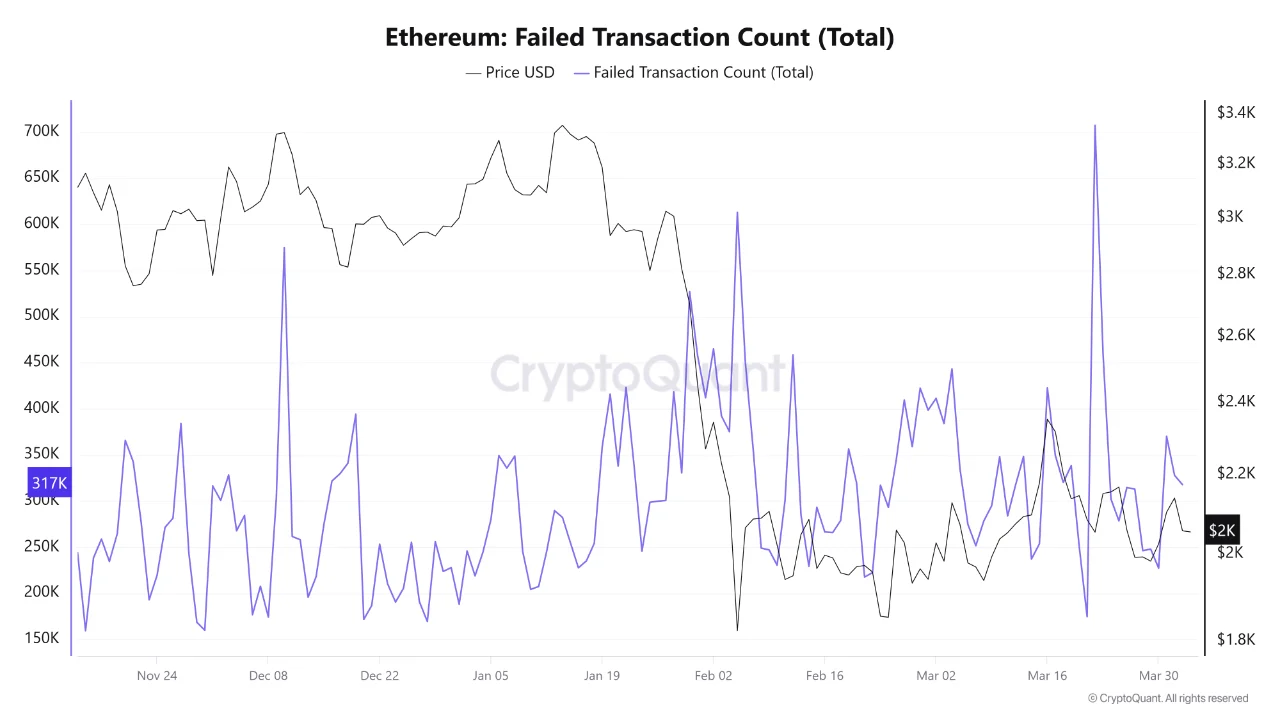
Out of 1.85 million total transactions that day, more than 35% failed. What makes the number more significant is that total transaction count actually fell on March 22, meaning the spike in failures cannot be attributed to a surge in activity overwhelming the network. The failures happened despite lower overall usage.
This was not an isolated event. CryptoQuant’s chart shows three distinct failure spikes since November 2025, December, February, and the March 22 peak. The average daily failure count has been rising gradually across all three. The direction is consistent and worsening.
Three Possible Explanations
The sender, the smart contract, and the blockchain itself are the three points where an Ethereum transaction can fail, and the rising failure rate implicates all three without clearly absolving any.
Users submitting insufficient gas, misconfiguring transactions, or failing to navigate increasingly complex DeFi interactions would explain a gradual upward drift in failures as the ecosystem grows more sophisticated. Less experienced users entering a more demanding environment is the most charitable explanation, and the one that places responsibility outside the development community.
The developer explanation is less comfortable. High development activity scores measure GitHub commits and repository events, not code quality. A team pushing large volumes of commits can simultaneously be shipping contracts with higher failure rates if speed is prioritized over testing. The Santiment rankings would not distinguish between the two.
The blockchain explanation is the most serious. If transaction processing reliability is deteriorating at the network level, separate from congestion, the March 22 spike on a day of lower-than-usual volume becomes harder to explain away. The data does not isolate which of these three is driving the trend. All three may be contributing simultaneously.
What Both Datasets Together Actually Show
Development activity rankings and failed transaction rates are measuring two different things.
The Santiment rankings measure quantity, GitHub commits, pull requests, code reviews, repository events. A high score confirms teams are working actively. It does not confirm that work is producing better outcomes for users. Chainlink’s result means its developers are among the most active in the ecosystem. It says nothing about whether that activity is reducing oracle failures, improving data reliability, or making the network more dependable.
The Ethereum failed transaction data measures outcome, what percentage of on-chain activity actually succeeds. A rising failure rate alongside rising development activity is not a contradiction. It is a warning. It suggests the rate of complexity being added to the ecosystem may be outpacing the rate at which that complexity is being made reliable for end users.
The Solana ecosystem’s development leaders are building actively. The question is not how much they are building. It is whether what they are building works.
The information provided in this article is for educational purposes only and does not constitute financial, investment, or trading advice. Coindoo.com does not endorse or recommend any specific investment strategy or cryptocurrency. Always conduct your own research and consult with a licensed financial advisor before making any investment decisions.
The post Solana’s Ecosystem Is Building Fast: Ethereum’s Data Questions Whether It Matters appeared first on Coindoo.
Source: https://coindoo.com/solanas-ecosystem-is-building-fast-ethereums-data-questions-whether-it-matters/


More Crypto News
Check our Market Overview
Disclaimer: This article is for informational purposes only and does not constitute financial advice. Always conduct your own research (DYOR).