
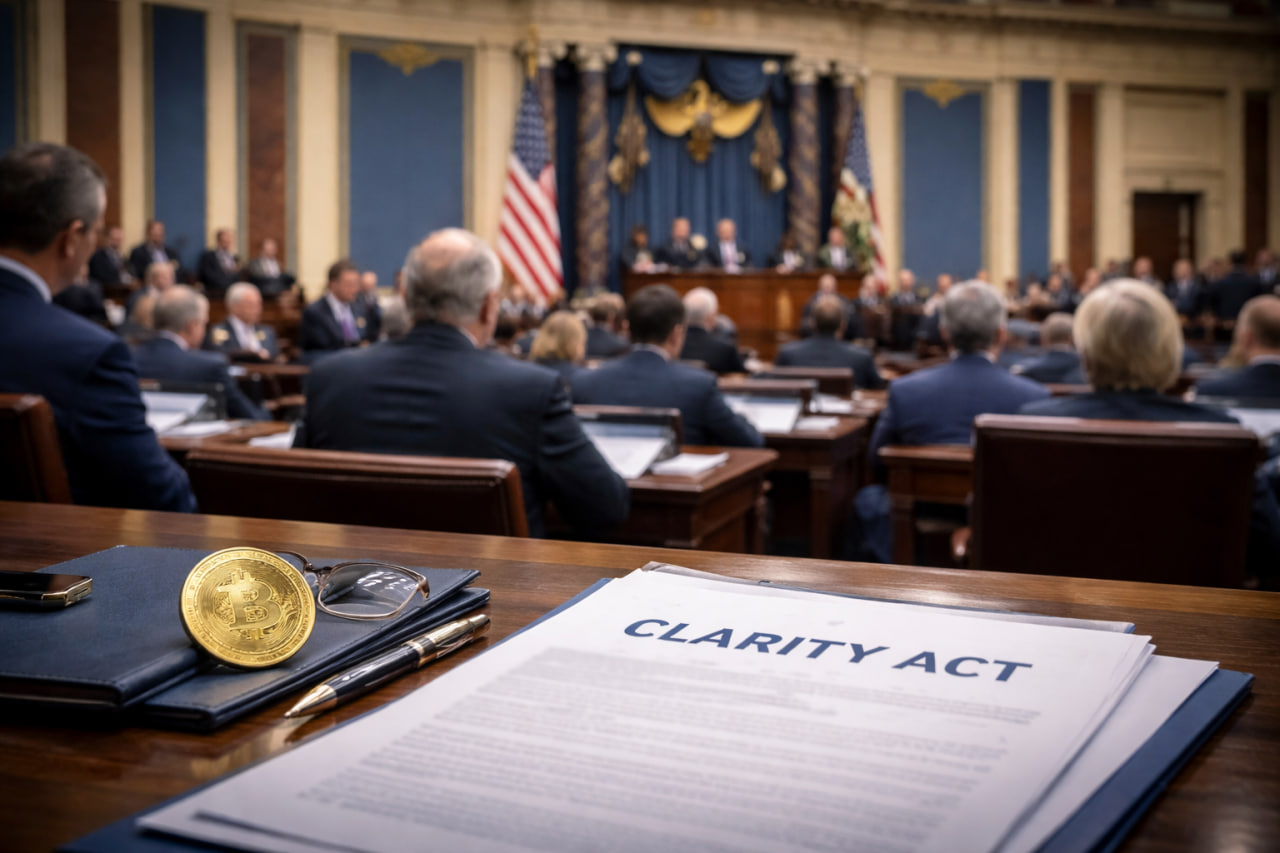
Key Takeaways Senator Cynthia Lummis warned on April 10 that this is the “last chance” to pass the bill before […]
The post U.S. Senator Warns Congress’ Time to Pass the CLARITY Act Is Almost Up appeared first on Coindoo.
Key Takeaways
- Senator Cynthia Lummis warned on April 10 that this is the “last chance” to pass the bill before at least 2030.
- CLARITY Act passed the House 294-134 in July 2025, but still faces five steps before becoming law.
- The Senate Banking Committee must complete its markup before end of April 2026, or the bill dies until after the midterms.
- Polymarket currently prices the bill’s passage this year at 63-66%.
Miss that window, and the next realistic opportunity for comparable legislation may not arrive until after the November 2026 midterms. By some estimates, not until 2028.
The Senator Who Built This – and Won’t Be Around Much Longer
No single figure has pushed harder for this legislation than Senator Cynthia Lummis (R-WY), widely known in Washington circles as the “Crypto Queen” of the Senate. On April 10 she warned that the current window is the “last chance” to pass the bill until at least 2030. Her reasoning is not just about legislative calendars – it is also personal. Lummis’s own term ends in January 2027, and with her departure goes the most knowledgeable and committed crypto advocate the Senate has seen. No obvious successor has emerged on either side of the aisle, which means that if the bill stalls now, it may simply have no champion to carry it forward.


What the Bill Actually Does
The CLARITY Act, also known as H.R. 3633, already cleared the House 294-134 and passed through the Senate Agriculture Committee, putting it closer to becoming law than any previous attempt to establish a national framework for digital assets. At its core, the bill draws a hard line between “digital commodities” falling under the Commodity Futures Trading Commission (CFTC) and “digital securities” remaining under the Securities and Exchange Commission (SEC).
The SEC and CFTC jointly classified Bitcoin, Ethereum, Solana, and XRP as digital commodities on March 17, but that classification is an interpretive release, not statute – a future administration could reverse it. The CLARITY Act would make that classification permanent federal law. That distinction matters enormously to institutional investors: pension funds and insurance companies managing trillions in assets have largely stayed out of crypto precisely because the legal ground beneath it can shift with each new administration.
The Fight Nobody Can Fully Resolve
What remains is a markup vote in the Banking Committee, reconciliation with the Agriculture Committee version, a full Senate floor vote requiring 60 votes, reconciliation with the House-passed version, and a presidential signature. Five steps, a shrinking calendar, and at least one fight that has dragged on for months.

Banks have warned that allowing crypto firms to offer yield on stablecoins would pull trillions of dollars away from traditional bank deposits toward digital assets. The crypto industry argues the opposite – that banning stablecoin yield is competitive protection for banks dressed up as consumer concern. Senators Tillis and Alsobrooks reached a compromise in principle on March 20, banning passive yield while permitting activity-based rewards tied to platform use, though key players including Coinbase and Stripe have still not fully accepted the text.
Beyond stablecoin yield, the bill also faced contested ground on illicit finance protections in decentralized finance, and a Democratic push to bar senior government officials – most pointedly President Trump – from profiting in the crypto sector. Patrick Witt, the White House’s chief crypto adviser, told CoinDesk TV on Monday that negotiations had made considerable progress on most of these issues and are “very close to closing them out.”
Treasury Secretary Scott Bessent put the stakes plainly in a Wall Street Journal op-ed on April 9 – blockchain developers and crypto companies are already relocating to Singapore and Abu Dhabi because those jurisdictions built clear regulatory frameworks first. Europe’s MiCA framework is already operational, while the U.S. is still debating committee scheduling. The argument that U.S.-regulated stablecoins backed by Treasuries could reinforce dollar dominance globally is one Lummis and others have leaned on heavily, framing the bill not just as crypto policy but as a matter of financial statecraft.
What Happens If It Fails
Peter Van Valkenburgh of Coin Center framed the bill’s purpose this way: passing the CLARITY Act is not about trusting the current administration, but about binding the next one. That is the more durable argument for the legislation – a statutory framework cannot be dismantled by executive order the way an administrative classification can. Critics, including Cardano’s Charles Hoskinson, have described the bill as something that could itself be weaponized against the industry under a future hostile administration, which is a reasonable concern given that broad regulatory authority tends to serve whoever holds it.
If the Banking Committee fails to schedule a markup before May, midterm election dynamics will almost certainly shelve the bill for the remainder of 2026. Polymarket currently assigns a 63-66% probability of passage this year, a figure that will move depending on decisions made this week and next.On April 16, the SEC hosts a roundtable specifically on the CLARITY Act – not a vote, but a public signal of regulatory direction before Congress acts.
With Lummis heading for the exit in nine months, and midterm campaigns set to crowd out legislative space by summer, the Banking Committee’s late-April markup window is not just a procedural milestone. It may be the last one that matters for years. This is significant moment for the whole crypto industry – if the act isn’t passed, the U.S. are risking falling significantly behind other countries will well established digital asset frameworks.
The information provided in this article is for educational purposes only and does not constitute financial, investment, or trading advice. Coindoo.com does not endorse or recommend any specific investment strategy or cryptocurrency. Always conduct your own research and consult with a licensed financial advisor before making any investment decisions.
The post U.S. Senator Warns Congress’ Time to Pass the CLARITY Act Is Almost Up appeared first on Coindoo.
Source: https://coindoo.com/u-s-senator-warns-congress-time-to-pass-the-clarity-act-is-almost-up/


More Crypto News
Check our Market Overview
Disclaimer: This article is for informational purposes only and does not constitute financial advice. Always conduct your own research (DYOR).