
Key Takeaways Humanity led the category with 27.61% weekly gain. Tezos rose 19.86%, Zcash added 18.38%. Zcash’s Ironwood upgrade targets […]
The post Privacy Coins Jump Up to 27% as Nine of Top Ten Turn Green appeared first on Coindoo.
Key Takeaways
- Humanity led the category with 27.61% weekly gain.
- Tezos rose 19.86%, Zcash added 18.38%.
- Zcash’s Ironwood upgrade targets July activation.
- Canton was the only top-10 decliner.
What Counts as a Privacy Coin
The category is broader than the classic image of anonymous digital cash. At the basic level, privacy coins are cryptocurrencies designed to conceal some or all transaction details, the sender, the recipient, the amount, or all three, using cryptographic techniques such as zero-knowledge proofs, ring signatures, and stealth addresses. On a transparent blockchain like Bitcoin’s, every transaction is permanently visible and traceable by anyone; privacy coins exist to close that gap, serving users who treat financial confidentiality the way traditional banking treats it: as a default, not a luxury.
The practical use cases run wider than the reputation suggests. Individuals use them to shield savings and salaries from public view, businesses use them to keep supplier payments and payroll confidential from competitors, and users in surveillance-heavy or capital-controlled jurisdictions rely on them where visible crypto holdings carry personal risk. The same technology also has a compliance-friendly face: selective disclosure lets a user prove a payment happened to an auditor or tax authority without exposing their entire financial history to the world.
CoinMarketCap’s privacy coins data reflects that range, spanning three distinct types of projects. The first is true privacy coins, Zcash, Monero, Dash, where hiding transaction details is the core product. The second is major chains that added optional confidential features, such as Litecoin and Tezos. The third is zero-knowledge infrastructure, where the same cryptography serves scaling, identity, or institutional data protection rather than anonymity, and this is where traditional finance has quietly entered the category.

Canton, built by Digital Asset, is the clearest example: its privacy-enabled network is used by major financial institutions, with participants across banking and market infrastructure, because banks cannot legally broadcast client positions on a transparent ledger, confidentiality is a regulatory requirement for them, not a preference. The distinction matters when reading the week’s numbers: regulators treat anonymity-by-default coins and permissioned confidentiality very differently, and the buying was not concentrated in one type. It spread across all three.
The Week’s Numbers
- Humanity Protocol led the category with a 27.61% gain.
- Tezos rose 19.86%, followed by Zcash at 18.38%.
- Midnight gained 9.16%, Chainlink added 8.77%, and Dash climbed 7.43%.
- Starknet, Monero, and Litecoin advanced 5.08%, 4.33%, and 4.03%, respectively.
- Canton was the only top-10 decliner, falling 7.96%.
- The overall crypto market gained roughly 5%, meaning most assets in the category outperformed the broader market.
The Core Privacy Coins
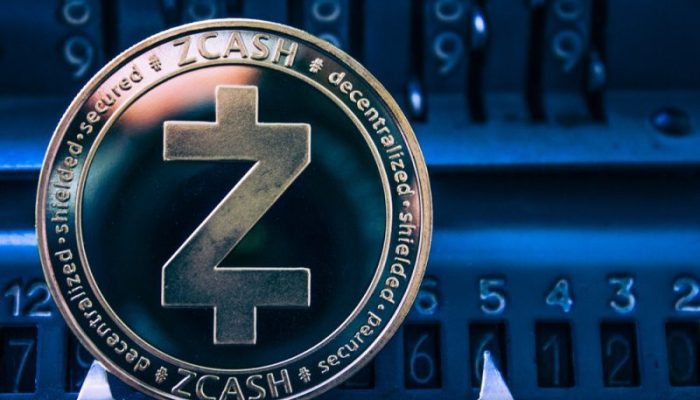
Zcash (ZEC, $455) pioneered zk-SNARK encryption, letting users choose between transparent and shielded transactions that hide sender, recipient, and amount. Its rally has an on-chain anchor: over 30% of the circulating supply now sits in the shielded pool, an all-time high per CoinGecko, indicating the privacy features are actually being used rather than merely traded.
The asset also carries the sector’s most prominent institutional storyline. BitMEX co-founder Arthur Hayes made ZEC his fund Maelstrom’s largest holding outside Bitcoin, calling it “Bitcoin with complete privacy,” before liquidating the entire position in June when the Orchard pool vulnerability was disclosed, noting he may buy back in if his supply-integrity concerns prove unfounded. That is precisely what the next catalyst addresses: the network finalized its Ironwood upgrade plan targeting July activation, designed to restore verifiable supply integrity, making this month a direct test of whether the sector’s most-watched exit reverses.
Monero (XMR, $322) is the maximalist version: privacy is mandatory, not optional. Ring signatures, stealth addresses, and confidential transactions obscure every transfer by default, which makes XMR fully fungible and also explains why it faces the heaviest exchange delistings. A recent analyst outlook via CryptoRank frames the trade-off: models project a $400–$600 test if a privacy-driven cycle materializes, against structural headwinds from FATF Travel Rule enforcement, with a mid-2026 network upgrade reducing transaction sizes as the next milestone.
Dash (DASH, $34.8) is the lightest touch of the three, offering opt-in mixing through PrivateSend built on CoinJoin, while functioning primarily as a payments network.
The Privacy-Enabled Majors
Litecoin (LTC, $44.6) earns its category spot through MWEB, the MimbleWimble Extension Blocks upgrade that added opt-in confidential transactions to one of crypto’s oldest payment chains. Tezos (XTZ, $0.25), this week’s second-best performer, supports Sapling shielded transactions, the same cryptographic family Zcash developed, at the protocol level. Chainlink (LINK, $7.8) is the least intuitive entry: it appears via DECO, its zero-knowledge oracle technology that lets users prove facts about private data without revealing the data itself, privacy as infrastructure rather than anonymous money.
The Zero-Knowledge Infrastructure Wing
Starknet (STRK, $0.03) uses STARK proofs to scale Ethereum, with the privacy potential of the underlying math still largely unexploited. Midnight (NIGHT, $0.033) is a data-protection chain from the Cardano ecosystem, built for selective disclosure so businesses can use blockchains without exposing sensitive records. Humanity Protocol (H, $0.07), the week’s top gainer, applies zero-knowledge proofs to identity, verifying personhood through palm biometrics without exposing the biometric data. Canton (CC, $0.14), the week’s lone decliner, is the institutional outlier: a privacy-enabled network built by Digital Asset and used by major financial firms, where confidentiality serves compliance rather than anonymity.

Why the Sector Is Moving
The rotation has a coherent logic. Financial surveillance is expanding, tax authorities increasingly parse transparent blockchains directly, and transparent-chain holdings are trivially traceable, which converts privacy from an ideological preference into a practical hedge.
The thesis has prominent backers: Hayes declared privacy the dominant crypto narrative of 2026 in his essay “Suavemente,” arguing AI-driven chain analysis is eroding pseudonymity, and Naval Ravikant, CEO of AngelList, has publicly backed Zcash with similar framing, per Yahoo Finance.
The shielded-supply growth in Zcash is the cleanest evidence that demand is functional, not just speculative. At the same time, the category carries a permanent discount: MiCA-era compliance rules restrict how European exchanges handle shielded transfers, and privacy-by-default assets like Monero remain delisted from several major venues, which caps liquidity precisely when demand rises.
The week’s pattern, with identity and ZK-infrastructure projects outperforming the classic privacy coins, suggests the market could be buying the broader confidential-computing thesis rather than just anonymous payments. That is the more durable version of the trade: infrastructure privacy faces far less regulatory friction than transaction anonymity while riding the same surveillance narrative. The catalysts ahead are specific and dated, Zcash’s Ironwood activation this month and Monero’s mid-2026 upgrade, which gives the sector something most crypto narratives lack: a calendar. The regulatory ceiling has not moved, but within it, this remains one of the few categories in the market where usage data, upgrade schedules, and price are currently pointing the same direction.
This article is for informational purposes only and does not constitute financial or investment advice. Cryptocurrency markets are highly volatile. Always conduct your own research before making investment decisions.
The post Privacy Coins Jump Up to 27% as Nine of Top Ten Turn Green appeared first on Coindoo.
Source: https://coindoo.com/privacy-coins-jump-nine-turn-green/


More Crypto News
Check our Market Overview
Disclaimer: This article is for informational purposes only and does not constitute financial advice. Always conduct your own research (DYOR).